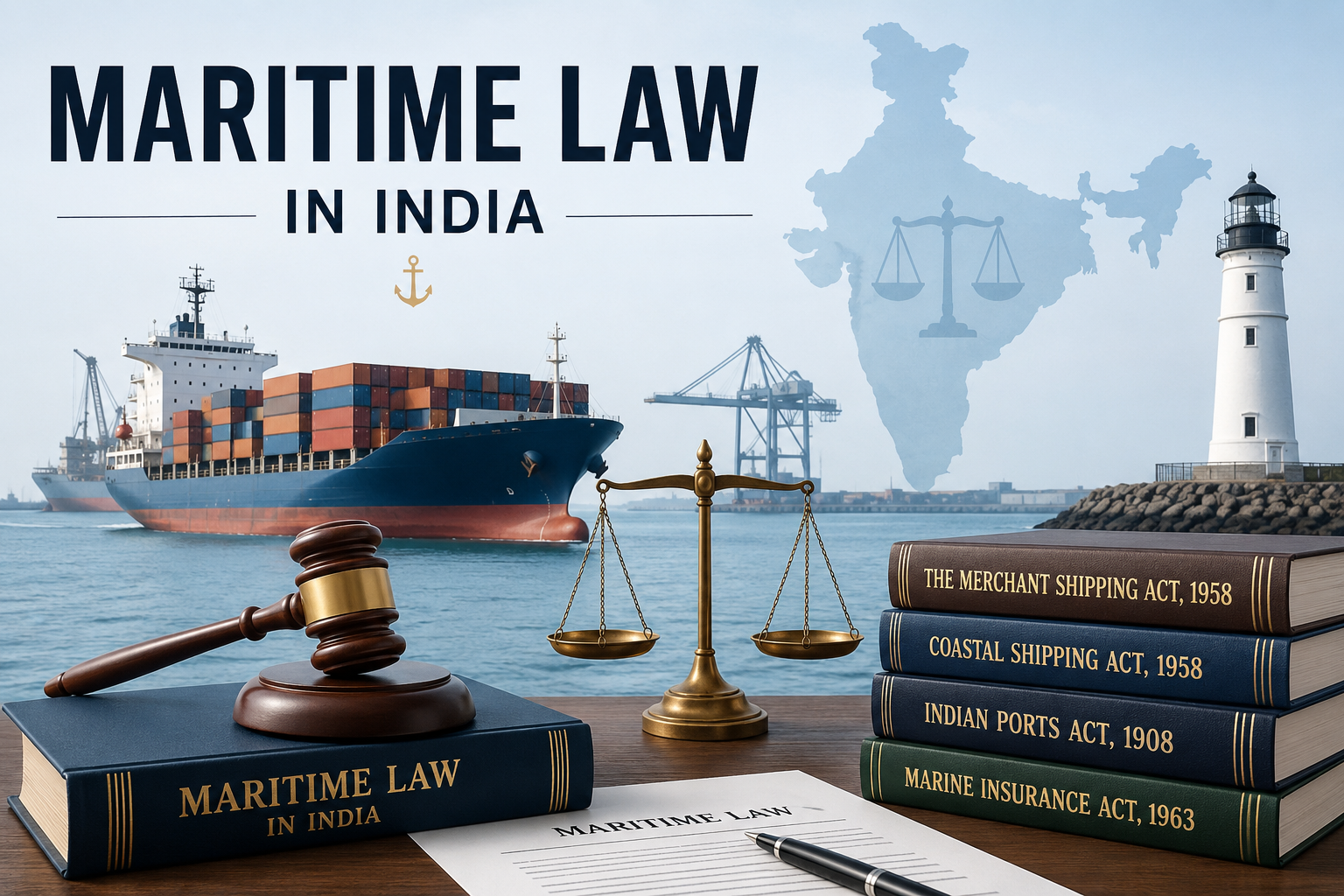
India’s maritime law has just undergone its biggest transformation in nearly a century. In 2025, Parliament enacted four landmark legislations — the Merchant Shipping Bill, the Carriage of Goods by Sea Bill, the Coastal Shipping Bill, and the Indian Ports Bill — to replace colonial-era statutes and bring maritime law in India in step with global standards set by the International Maritime Organization (IMO). If you’ve been searching for a clear, no-jargon breakdown of what changed and why it matters, this guide answers the most common questions about India’s new maritime law framework, in plain Q&A format.
What Are the Key Takeaways of India’s Maritime Law Reform?
- Four new bills now govern India’s maritime law: Merchant Shipping Bill 2025, Carriage of Goods by Sea Bill 2025, Coastal Shipping Bill 2025, and Indian Ports Bill 2025.
- These laws replace colonial-era statutes — the Merchant Shipping Act 1958, the Indian Carriage of Goods by Sea Act 1925, and the Indian Ports Act 1908.
- The reform aligns Indian maritime law with global conventions such as SOLAS, MARPOL, MLC, and the Hague-Visby Rules.
- Parliament’s authority rests on Article 253 (treaty implementation) and Entry 25 of the Union List (shipping and navigation).
- India’s maritime sector handles ~95% of foreign trade by volume and over 70% by value, making this reform economically significant.
- The government has paired the legal overhaul with a $20 billion investment roadmap, the Maritime Development Fund (₹25,000 crore), and Maritime Vision 2047, aiming to make India a top-5 shipbuilding nation.
- The goal: position India as a trusted, transparent, and globally competitive maritime hub.
What Is Maritime Law, and Why Did India Need to Reform It?
Maritime law (also called admiralty law) is the body of rules governing shipping, navigation, ports, cargo transport, and the rights and liabilities of everyone involved in sea trade. India’s maritime law had not kept pace with global shipping practice for decades — its core statutes dated back to 1908, 1925, and 1958, all rooted in colonial-era priorities. As global trade, vessel technology, environmental standards, and IMO conventions evolved, India’s outdated maritime law created compliance gaps, legal uncertainty, and a competitive disadvantage for Indian shipping companies and ports.
What Are the Four New Maritime Law Bills Passed by Parliament in 2025?
The four bills that now form the backbone of India’s maritime law are:
- Merchant Shipping Bill, 2025 — replaces the Merchant Shipping Act, 1958
- Carriage of Goods by Sea Bill, 2025 — replaces the Indian Carriage of Goods by Sea Act, 1925
- Coastal Shipping Bill, 2025 — replaces Part XIV of the Merchant Shipping Act, 1958
- Indian Ports Bill, 2025 — replaces the Indian Ports Act, 1908
Together, these bills represent a complete overhaul of India’s maritime law ecosystem — covering vessels, cargo, coastal trade, and port governance.
What Does the Merchant Shipping Bill, 2025 Change Under Maritime Law?
The Merchant Shipping Bill, 2025 is the centerpiece of the new maritime law framework. Spread across 16 Parts and 325 clauses, it:
- Expands eligibility and ownership criteria for registering vessels under the Indian flag
- Empowers the government to detain stateless vessels, strengthening maritime security
- Introduces stronger safety, emergency preparedness, and environmental safeguards aligned with IMO protocols
- Prioritizes seafarer welfare for both Indian and foreign crew
- Replaces the bulky 1958 Act with a streamlined, transparent compliance structure
- Encourages more ships to register under the Indian flag, boosting Indian tonnage
In short, this part of India’s maritime law shifts the approach from heavy-handed regulation to an enabling, growth-oriented policy.
How Does the Carriage of Goods by Sea Bill, 2025 Affect Maritime Law on Cargo Liability?
This bill modernizes the maritime law governing who is responsible when cargo is lost or damaged at sea. It repeals the 1925 Act and aligns India with the Hague-Visby Rules (1924, amended 1968 and 1979) — the internationally recognized backbone of cargo liability law. Key changes include:
- Clear definitions of carrier liability for cargo loss or damage
- Updated regulation of bills of lading (the core shipping documents)
- Simplified contractual rights, reducing disputes and litigation
- Government powers to issue directions and update rules as needed
Notably, India had continued using a law based only on the original 1924 Hague Rules — decades after most maritime nations moved to the updated Hague-Visby framework. This delay often pushed shipping disputes involving India into foreign arbitration rather than under domestic maritime law.
What Is the Role of the Coastal Shipping Bill, 2025 in India’s Maritime Law?
The Coastal Shipping Bill, 2025 focuses on maritime law as it applies to India’s own coastline — 9 states and 4 Union Territories. Structured in 6 chapters and 42 clauses, it:
- Introduces simplified licensing for coastal shipping participants
- Regulates foreign vessels operating in India’s coastal trade to protect national interests
- Targets coastal cargo capacity of 230 million tonnes by 2030
- Mandates a National Database for Coastal Shipping for real-time data
- Requires a National Coastal and Inland Shipping Strategic Plan
- Reduces dependence on foreign vessels, saving foreign exchange and creating jobs
This piece of maritime law directly supports India’s Atmanirbhar Bharat (self-reliant India) and Viksit Bharat (developed India) visions.
What Does the Indian Ports Bill, 2025 Add to India’s Maritime Law Framework?
The Indian Ports Bill, 2025 replaces the 108-year-old Indian Ports Act, 1908, bringing port governance into the modern maritime law framework. It aims to:
- Reduce logistics costs through faster cargo movement
- Improve port connectivity and ease of doing business via digitization
- Strengthen sustainability with pollution control and disaster management plans
- Increase port competitiveness through transparent tariffs and investment-friendly rules
- Reinforce cooperative federalism via a Maritime State Development Council and empowered State Maritime Boards
How Does India’s Maritime Law Compare Internationally?
India’s maritime law reform mirrors steps already taken by leading maritime nations:
- Singapore revised its Merchant Shipping Act in 1996 and 2001 to comply with MARPOL, SOLAS, and the Maritime Labour Convention (MLC)
- Norway adopted the Ship Safety and Security Act (2007) along with Maritime Code updates to match IMO and EU standards
- Japan modernized its Maritime Transport Law and Port Regulations, incorporating IMO greenhouse gas emission standards
India’s 2025 reforms close a long-standing gap, bringing domestic maritime law in line with global best practice rather than lagging behind it.
What Is the Constitutional Backing for These Maritime Law Reforms?
India’s maritime law changes rest on solid constitutional ground:
- Article 253 allows Parliament to legislate to implement international treaties and conventions — even on subjects that would otherwise fall under the State List. This lets the new bills draw authority from India’s commitments under SOLAS, MARPOL, and MLC.
- Entry 25 of the Union List gives the Central Government exclusive power over shipping and navigation, ensuring uniform maritime law across all Indian ports and states.
- Judicial precedent — the Supreme Court has repeatedly upheld Parliament’s competence over maritime law matters, including carrier liability and admiralty jurisdiction.
Why Does Maritime Law Matter for India’s Economy?
Maritime law isn’t just a legal technicality — it underpins a massive share of India’s economy:
- India has a coastline of roughly 7,517 km across 9 states and 4 Union Territories
- The maritime sector handles about 95% of India’s foreign trade by volume and over 70% by value
- India has 12 major ports, 200+ minor and intermediate ports, and about 30 shipyards
- Major ports’ cargo-handling capacity grew 87% between 2014 and 2024, reaching 1,629.86 million tonnes, with 819.22 million tonnes handled in FY24
- India’s registered fleet stands at 1,530 ships, ranking it the 20th largest merchant shipping fleet among developing nations
A modern maritime law framework directly supports trade efficiency, investor confidence, and economic growth at this scale.
What Government Initiatives Support India’s Maritime Law and Maritime Vision 2047?
Alongside the legal reforms, the government has launched several initiatives to operationalize India’s new maritime law:
- A $20 billion investment roadmap (2025) for shipping infrastructure, shipbuilding, port digitization, and green fuels
- Agreements with Norway and Denmark on Arctic shipping, shipbuilding technology, and green hydrogen
- Three Green Hydrogen Hub Ports at Kandla, Paradip, and Tuticorin
- Strategic corridors like IMEEC, the Eastern Maritime Corridor, and INSTC
- One Nation–One Port (ONOP), cutting documentation by 33%
- The MAITRI platform, using AI and blockchain for trade documentation
- Sagar Ankalan (LPPI) to benchmark port performance
- The National Centre of Excellence in Green Port & Shipping (NCoEGPS) and Green Tug Transition Program (sustainable harbor tugs by 2040)
- Shipbuilding Financial Assistance Policy (SBFAP) 2.0 with a ₹18,090 crore allocation under Maritime Amrit Kaal Vision 2047
- A Maritime Development Fund worth ₹25,000 crore
- 100% FDI allowed in shipping
- 26 new national inland waterways for multimodal cargo connectivity
All of this feeds into Maritime Vision 2047, the Prime Minister’s roadmap to make India one of the world’s top maritime nations by 2047.
To monitor ongoing diplomatic shifts, bilateral defense treaties, and regional economic breakthroughs across the Indo-Pacific, visit NewsCanvassEdu.