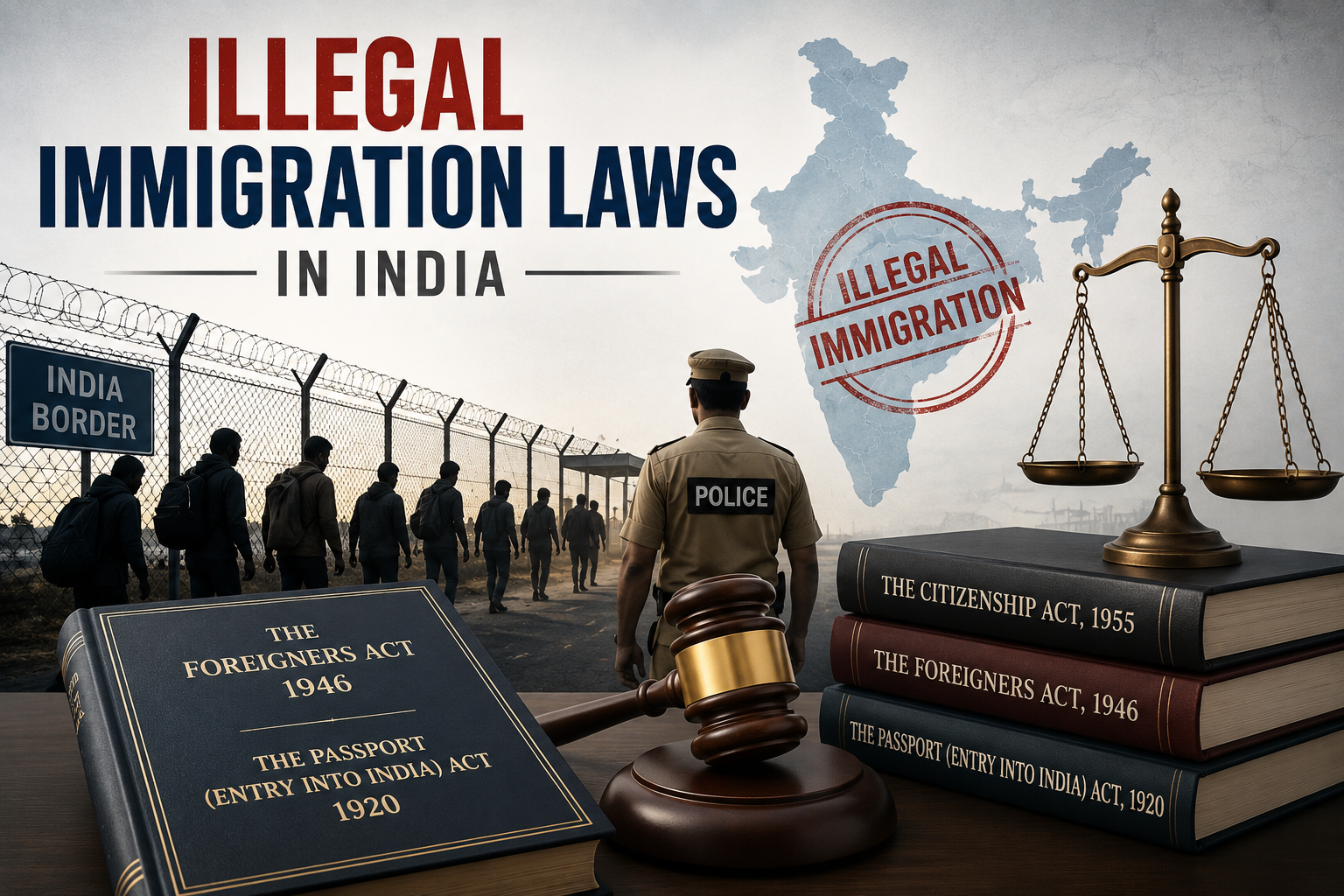
National security, border control, and human rights have taken center stage in South Asian geopolitical discussions. Following the major regime shift in Bangladesh and heightened security footprints along eastern borders, the enforcement of illegal immigration laws in India has significantly intensified.
For students and UPSC aspirants, parsing through this complex legal framework is critical. From border security actions to sweeping new statutory updates, India’s management of undocumented migrants involves a fine balance between state sovereignty and fundamental constitutional rights.
The Catalyst: Why India Intensified Border Enforcement
Following the August 2024 regime change in Bangladesh, the Union Home Ministry directed state police forces to rapidly detect unauthorized immigrants and crack down on those using forged documents.
Post-2025 Escalation: ‘Operation Sindoor’
Security operations scaled up dramatically following the April 2025 Pahalgam terror attack under a unified national strategy called ‘Operation Sindoor’. Under this directive, the Ministry of Home Affairs (MHA) ordered strict action against undocumented crossings, leading to a massive increase in border security interventions.
However, this crackdown has sparked significant controversy. In recent incidents, border security operations have faced criticism after residents from West Bengal and Assam were pushed across the border under the suspicion of being illegal migrants, only to be returned after state interventions proved they were either legal Indian citizens or that their citizenship status was sub-judice (under judicial consideration).
Deportation vs Pushback: Two Very Different Realities
When studying illegal immigration laws in India, it is vital to distinguish between a formal legal exit and an informal border eviction.
| Feature | Deportation (The Legal Route) | Pushback (The Informal Practice) |
| Legal Procedure | Strictly codified; requires arrest, formal detention, and judicial presentation. | Lacks formal procedure, codified rulebooks, or direct judicial oversight. |
| Authority Involved | Coordinates via MHA, Foreigners Regional Registration Office (FRRO), and embassies. | Executed directly by Border Security Force (BSF) personnel at the international border. |
| Identity Check | Handled with foreign government cooperation after legal options are exhausted. | Relies on the immediate, localized discretion of border guarding forces. |
| Processing | Formal, documented, and state-sanctioned exit. | Individuals are informally returned across boundaries without processing. |
Modernizing the Legal Slate: The Immigration and Foreigners Act, 2025
For decades, India managed cross-border movement via colonial-era statutes. This changed completely when the central government enacted the landmark Immigration and Foreigners Act, 2025, which officially came into operational force on September 1, 2025.
This single, consolidated law modernizes enforcement and completely replaces four historic pieces of legislation:
- The Passport (Entry into India) Act, 1920
- The Registration of Foreigners Act, 1939
- The Foreigners Act, 1946
- The Immigration (Carriers’ Liability) Act, 2000
Key Structural Provisions under the 2025 Framework
- The Bureau of Immigration (BoI): The Act transforms the BoI into an empowered statutory authority governing all visa issuances, border controls, and centralized registrations.
- Mandatory reporting: It enforces strict tracking. Foreign nationals must register with their local Registration Officer within a strict timeframe. Furthermore, educational institutions, hospitals, hotels, and local households are legally mandated to report foreign visitors or face severe liability.
- Strict Penalties: Violating illegal immigration laws in India through unauthorized entry or overstaying now incurs clear statutory punishments—including up to 5 years of rigorous imprisonment, a fine of up to ₹5 Lakhs, or both.
Navigating the Jurisdictional Grid
Who actually holds the power to remove a foreign national? Under the Constitution of India, matters concerning “Citizenship, naturalisation and aliens” fall squarely under the Union List (Seventh Schedule).
However, because there is no dedicated central police force exclusively tasked with executing civilian deportations, the Ministry of Home Affairs formally delegates these powers directly to State Government police forces. As the MHA clarified before the High Court, the operational burden of identifying, verifying, and holding undocumented individuals pending legal deportation rests with state-level law enforcement networks.
What the Courts Have Said: Landmark Judicial Precedents
The enforcement of illegal immigration laws in India must constantly square itself with constitutional protections. Critics argue that arbitrary border pushbacks bypass due process and infringe upon fundamental human rights.
1.Maneka Gandhi v. Union of India:1978 Supreme Court.
Established that any state-mandated procedure affecting personal liberty must be just, fair, and reasonable. It laid the groundwork that even non-citizens are entitled to procedural fairness.
2.NHRC v. State of Arunachal Pradesh:1996 Supreme Court.
The apex court expanded the umbrella of protection, ruling that the State is bound to protect the life and liberty of refugees (specifically Chakmas) under Article 21, affirming that fundamental rights apply to non-citizens.
3.Ktaer Abbas Habib Al Qutaifi v. UOI:1999 Gujarat High Court.
The court explicitly highlighted the international customary principle of non-refoulement—the practice of not forcing refugees to return to a country where they face persecution—as a core consideration for Indian authorities.
4.The Rohingya Deportation Case:2021 Supreme Court Order.
Marked a noticeable shift toward balancing human rights with national security concerns. The Court did not completely block deportations but strictly maintained that any removal must rigorously follow established legal procedures.
India’s Refugee Policy: Where the Law Falls Silent
Despite handling some of the largest migration influxes in modern South Asian history, India does not possess a specific, dedicated refugee law. Instead, refugees, asylum seekers, and undocumented migrants are all legally classified under the same broad umbrella of “foreigners.”
Furthermore, India is not a signatory to the 1951 UN Refugee Convention or its 1967 Protocol. New Delhi’s official stance attributes this to sovereign protections, resource limits, and the view that Eurocentric UN models fail to capture the complex demographic realities of South Asia.
Consequently, India utilizes an ad-hoc, administrative approach—offering structured humanitarian shelter and welfare to specific groups (like historical Tibetan or Sri Lankan Tamil communities) based on geopolitical balances, while treating other displaced communities strictly through standard immigration enforcement.
The South Asian Landscape: A Comparative Framework
To understand how India’s border strategies compare with its immediate neighbors, look at how different South Asian states manage displaced populations under their respective domestic legal regimes:
| Country | Legal Classification of Refugees | UNHCR Scope of Operation | Key Geopolitical Focus |
| India | Regulated as foreign nationals under the Immigration and Foreigners Act, 2025. | Monitored and restricted; handles select non-neighboring asylum cases. | Ad-hoc administrative model; strong focus on regional maritime security. |
| Pakistan | Governed strictly under general alien and passport acts. | Highly active; registers massive historical populations. | Camp-based framework centered primarily on Afghan border migrations. |
| Bangladesh | No specific refugee code; managed via local statutory orders. | Strong institutional presence alongside state mechanisms. | Encampment policies focused heavily on temporary protection and repatriation. |
| Nepal | Handled through basic internal immigration frameworks. | Active leadership in international third-country resettlement. | Manages distinct historical corridors via strict border processing. |
To monitor ongoing diplomatic shifts, bilateral defense treaties, and regional economic breakthroughs across the Indo-Pacific, visit NewsCanvassEdu.