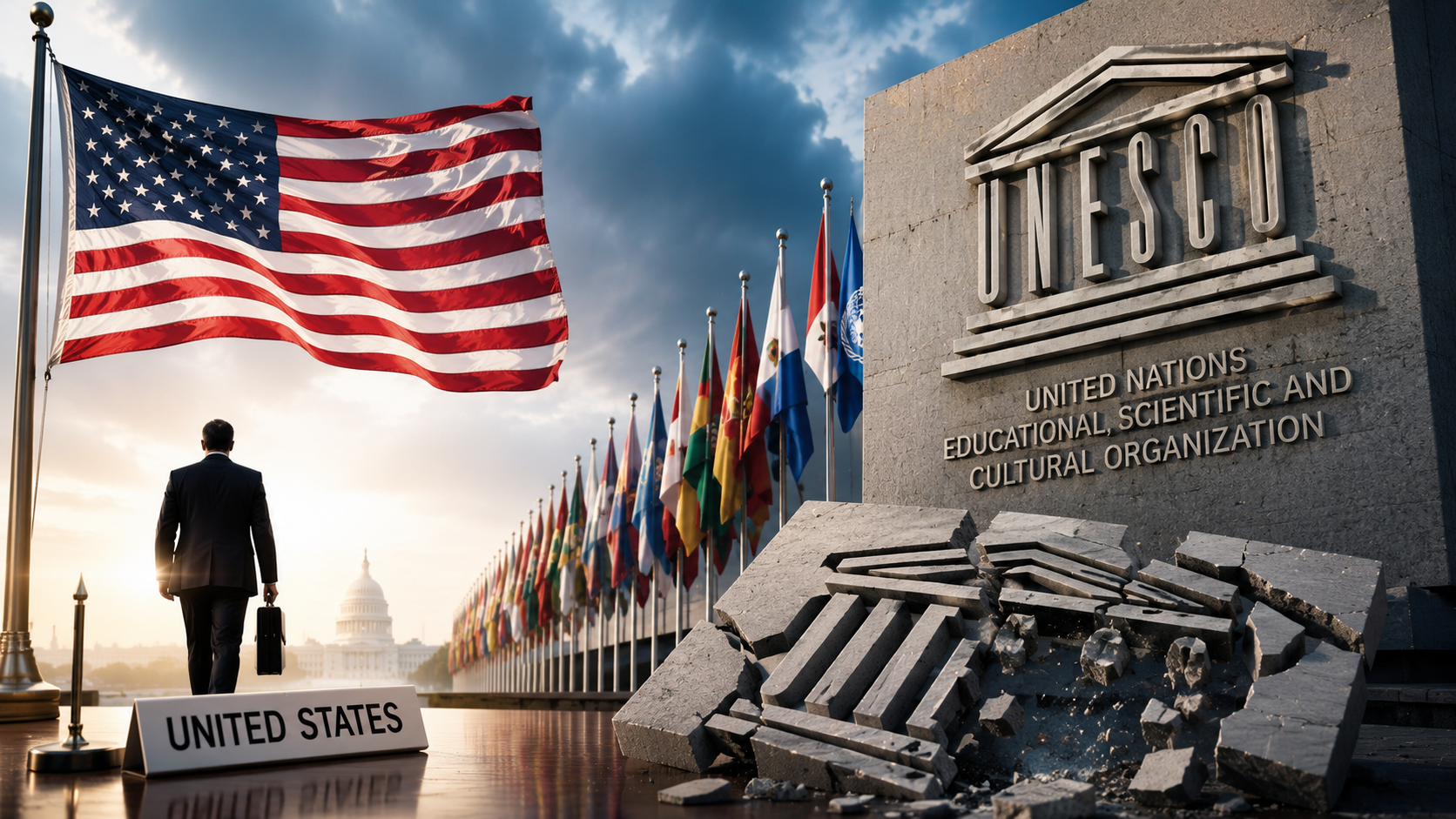
The landscape of global diplomacy is shifting dramatically. Following the major announcement of the US withdrawal from UNESCO, the international community is forced to re-evaluate the future of global cooperation.
While the official paperwork for the US withdrawal from UNESCO was initiated following a State Department announcement, the move was solidified into a massive geopolitical shift. President Donald Trump signed a comprehensive presidential memorandum directing immediate steps to effectuate the exit of the United States from 66 international organizations and 31 United Nations agencies.
Pursuant to Article II(6) of the UNESCO Constitution, the US withdrawal from UNESCO will become fully effective on December 31, 2026. Until that effective date, the US technically remains a full member, though its proactive influence has ground to a halt.
What Drove the US Withdrawal from UNESCO?
The strategic decision behind the US withdrawal from UNESCO stems from a fundamental pivot in American diplomacy. The current administration has consistently argued that continued involvement in the agency is no longer aligned with national interests.
- Ideological Differences & “America First”
The US State Department explicitly stated that UNESCO has evolved to advance “divisive social and cultural causes.” Under the administration’s Trump America First foreign policy, these initiatives are viewed as ideological distractions that pull resources away from domestic priorities.
- The Palestine Membership Flashpoint
A primary catalyst for the friction dates back to 2011, when UNESCO voted to admit the State of Palestine as a full member state. US federal law prohibited funding to UN bodies that granted full membership to groups lacking internationally recognized statehood. The administration maintains that this inclusion fosters anti-Israel rhetoric and directly contradicts long-standing American foreign policy.
- Opposition to Sustainable Development Goals (SDGs)
The US has leveled sharp criticism against UNESCO’s outsized focus on the United Nations Sustainable Development Goals (SDGs). White House officials have categorized the current framework as a “globalist, ideological agenda for international development” that compromises national sovereignty.
A History of Reversals: The On-Again, Off-Again Relationship
The US withdrawal from UNESCO in 2026 is not an isolated incident. Instead, it represents the third time the United States has walked away from the organization. The history of this relationship reflects the shifting political landscape and foreign policy priorities of changing administrations in Washington.
First Withdrawal: The Reagan Era- 1984
Under President Ronald Reagan, the United States executed its first formal exit from UNESCO. The administration cited severe financial mismanagement within the agency and a growing anti-Western ideological bias.
The Return Under Bush- 2003
After a nearly two-decade absence, the US officially rejoined the agency under President George W. Bush, signaling a renewed commitment to international diplomacy and global literacy goals.
The Funding Freeze- 2011
Following UNESCO’s historic decision to admit Palestine as a full member state, the Obama administration was legally forced to cease all financial contributions under US statutory law, creating an immediate budgetary deficit.
Second Formal Withdrawal- 2017–2018
During Donald Trump’s first term, the administration finalized a complete, formal exit from the organization, pointing to ongoing, systemic anti-Israel bias within UNESCO’s voting blocs.
The Biden Re-engagement-2023
President Joe Biden successfully negotiated a return to the organization, paying back hundreds of millions in back-dues. The primary goal was to reclaim a seat at the table to counter China’s surging influence over global tech and AI education standards.
The Third US Withdrawal from UNESCO-2025–2026
Following the start of the second Trump administration, the US once again initiated the official withdrawal process. This move is part of a sweeping, nationalist shift away from multi-party treaties, formalized by the historic January executive actions targeting dozens of international bodies.
What the US Withdrawal from UNESCO Means on the Ground
The systemic ripple effects of the US withdrawal from UNESCO extend far beyond organizational rosters, impacting cultural heritage, scientific research, and environmental protections globally.
Reduced US Influence and the Rise of China
By exiting the Paris-based agency, the US forfeits its seat at the table in shaping global standards for education, science, and the ethics of Artificial Intelligence (AI). This strategic vacuum allows geopolitical rivals, particularly China, to aggressively step in and write the rules for global governance.
Impact on World Heritage Sites and Cultural Preservation
While the 26 existing UNESCO World Heritage Sites inside the United States (such as the Grand Canyon and the Statue of Liberty) will retain their historical status, the US will lose its eligibility to nominate new sites. This leaves vulnerable historic and Indigenous landmarks—like Ohio’s Serpent Mound—without access to international recognition. Furthermore, local US communities face diminished access to international grants and preservation networks.
Disruption to Science and Education Cooperation
American researchers warn that leaving UNESCO will hamper vital cross-border academic collaborations. Key programs under threat include:
- Open science initiatives and universal teacher training frameworks.
- The coordination of global literacy and gender-equality education in crisis zones.
- Ethical frameworks regarding AI integration in classrooms.
Limited Budgetary Realities
Interestingly, the financial blow to UNESCO is less severe than in past decades. Following years of funding volatility, the US share of UNESCO’s operating budget had already dropped to roughly 8% (down from a historical 22%). The agency has successfully diversified its funding through private contributions and other member state donations, meaning immediate staff cuts are unlikely.
Environmental Safeguards at Risk
The exit injects uncertainty into global sustainability programs. Without US participation, cross-border corporate partnerships for ethical sourcing may weaken, potentially reducing structural safeguards against mining, drilling, and commercial exploitation near protected biosphere reserves.
India’s Strategic Opportunity in America’s Absence
As the US withdrawal from UNESCO alters the balance of power, India stands at a critical diplomatic crossroads. As a founding member that approved the UNESCO Constitution back on November 4, 1946, India boasts a legacy of deep engagement.
With the US exiting, India has a prime window to expand its soft power, champion South-South cooperation, and project its unique cultural perspectives directly into global policy formulations. New Delhi can actively lead conversations regarding the global ethics of AI and step up to secure more slots on the coveted World Heritage List.
The Risk Factor: The exit does create a funding deficit that could put localized strain on UNESCO-supported ecological and educational preservation projects within India, such as programs in Nalanda and the Sundarbans.
Educational Deep Dive: How UNESCO Works
To understand the weight of the US withdrawal from UNESCO, students must understand why the organization was built in the first place.
Founding and Post-War Vision
Born from the devastation of World War II, UNESCO (United Nations Educational, Scientific and Cultural Organization) was officially founded on November 16, 1945. Its core mission was revolutionary yet simple: to build peace in the minds of men and women through intellectual and moral solidarity, ensuring that a global conflict would never happen again.
Governance Structure
UNESCO operates via three foundational pillars headquartered in Paris, France:
- The General Conference: The primary decision-making body comprising representatives from all member states.
- The Executive Board: Assesses organizational programming and manages budget allocations.
- The Secretariat: The executive branch led by the Director-General (currently Audrey Azoulay), responsible for day-to-day implementation.
Historic Achievements
Over its history, UNESCO has achieved monumental wins for global civilization:
- Universal Education: Driving global progress toward Sustainable Development Goal 4 (SDG 4) to ensure equal access to quality education.
- Historic Restorations: Leading massive post-conflict recoveries, such as saving the Nubian Monuments from flooding in Egypt during the 1960s and restoring Angkor Wat in Cambodia.
- Scientific Breakthroughs: Initiating the foundation of CERN in 1954 and spearheading the Seabed 2030 Project to fully map the ocean floor.
- Disaster Preparedness: Developing and coordinating tsunami early-warning systems across every major ocean basin since the 1960s.
Part of a Broader Trend: The US UN Agencies Exit
The US withdrawal from UNESCO is not a singular foreign policy pivot. It is part of a sweeping, nationalist trend favoring bilateral (government-to-government) deals over multi-party treaties, often referred to as the broader US UN agencies exit.
| International Body | Year of US Exits | Primary Stated Reason for Exit |
| World Health Organization (WHO) | 2020, 2025/2026 | Dissatisfaction with pandemic handling; perceived neutrality failures. |
| UN Human Rights Council (UNHRC) | 2018, 2025/2026 | Alleged chronic anti-Israel bias and poor track records of member states. |
| Paris Climate Agreement | 2017, 2025/2026 | Protection of domestic energy markets; skepticis of global climate pacts. |
| Trans-Pacific Partnership (TPP) | 2017 | Protection of domestic manufacturing and labor forces from foreign competition. |
| UNRWA (Palestine Refugee Agency) | 2018, 2025/2026 | Claims of financial mismanagement and national security concerns. |
This systematic disengagement from international agreements marks a transformative era in global geopolitics, leaving other world powers to chart the path forward for global education, science, and human rights.
Track the evolution of global diplomacy, changing international treaties, and breaking geopolitical events with NewsCanvassEdu.