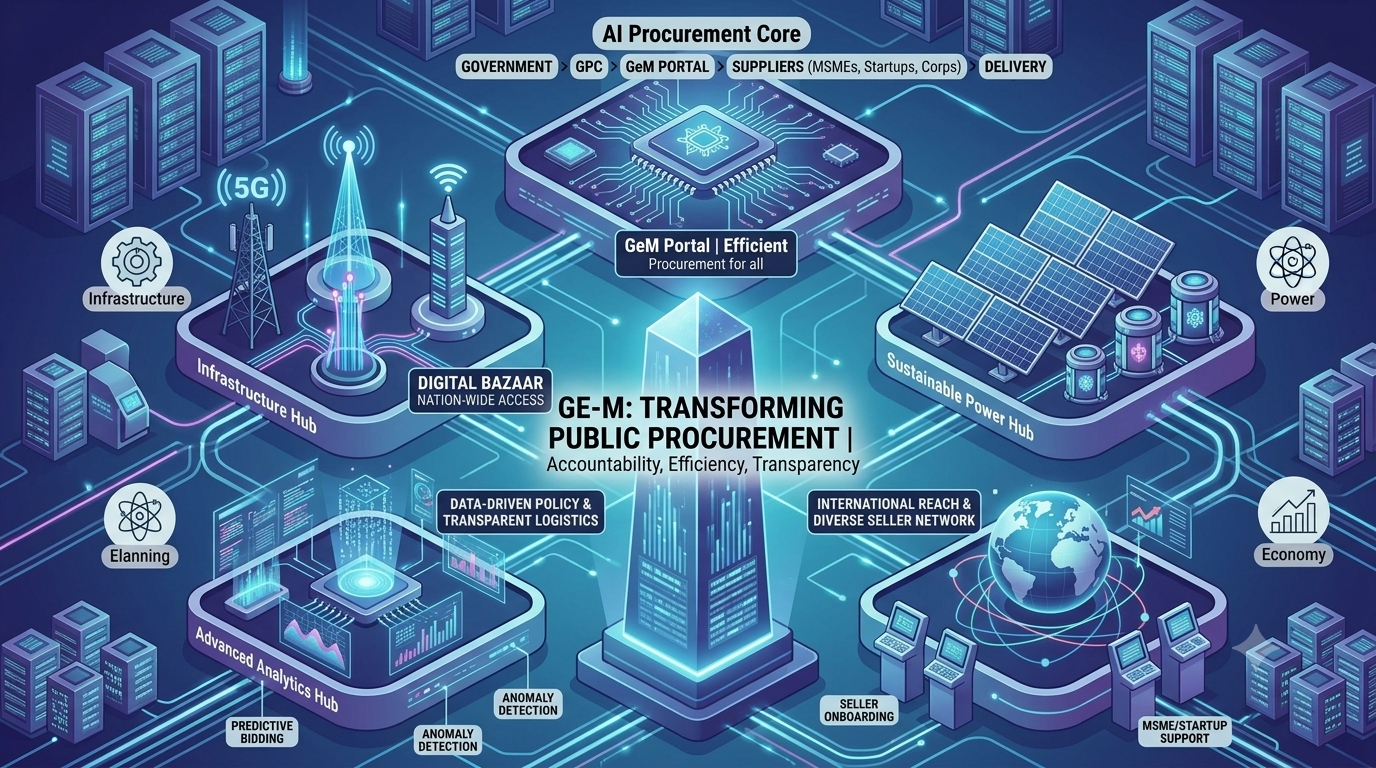
Public sector administration is undergoing a massive digital overhaul. Marking its 9th Foundation Day under the operational theme of “Ease, Access and Inclusion,” the Government e Marketplace India (GeM) has solidified its position as the cornerstone of the nation’s public procurement infrastructure.
Launched on August 9, 2016, by the Ministry of Commerce and Industry, GeM was engineered to replace the archaic, manual paper-file system previously managed by the Directorate General of Supplies and Disposals (DGS&D). Today, it stands as India’s premier online portal, executing end-to-end procurement of goods and services for central ministries, state departments, public sector undertakings (PSUs), autonomous institutions, and local civic bodies.
Ownership, Governance, and Platform Architecture
The Government e Marketplace India operates under a specialized corporate structure designed to combine public accountability with enterprise efficiency.
The GeM Special Purpose Vehicle (SPV)
GeM is owned and operated by the GeM SPV, a 100% government-owned, non-profit company. The SPV is entirely responsible for building, maintaining, and scaling the software architecture. By creating a fully digital, paperless, and contactless interface, the platform directly supports the executive vision of “Minimum Government, Maximum Governance.”
Key Technological Features
To streamline high-volume procurement, the platform leverages advanced digital tools:
- AI Integration: Utilizes the interactive GeM AI Chatbot to deliver real-time operational insights, responsive user support, and predictive pricing analytics.
- Fintech Convergence: Fully integrated across numerous banking networks to ensure seamless, secure, and automated escrow payment processing.
- Localized Outreach: Features voice-enabled navigation and multilingual training modules to bridge geographical barriers for rural sellers.
- Scale Optimization: Consolidates procurement demands across separate departments, unlocking significant economies of scale and better price discovery.
Growth Metrics: Scale and Economic Impact of Government e Marketplace India
By the conclusion of FY 2024–25, the Government e Marketplace India demonstrated unprecedented transactional volume, establishing itself as one of the largest public e-procurement portals globally.
- Cumulative Transaction Value: Passed ₹13.4 Lakh Crore+ since inception.
- FY 2024–25 Gross Merchandise Value (GMV): Crossed ₹5.4 Lakh Crore.
- Total Registered Buyers: Over 1.6 Lakh government entities, including village panchayats.
- Total Registered Sellers: Exceeded 22 Lakh active suppliers and service providers.
- Public Exchequer Savings: Generated over ₹1.15 Lakh Crore in cumulative savings.
The Cost Benefit: A comprehensive World Bank study revealed that shifting from traditional physical tenders to the GeM platform yielded an average cost savings of 9.75% for government buyers.
Inclusive Public Procurement: Empowering Grassroots Sellers
At its core, GeM is structured around inclusive public procurement GeM models, actively lowering entry barriers for traditionally marginalized demographic groups.
Specialized Onboarding Tracks
To foster economic equity, GeM runs targeted portals that bypass traditional supply chain gatekeepers:
- Womaniya: A dedicated initiative connecting over 1.8 lakh Udyam-verified, women-led enterprises directly to institutional buyers.
- Startup Runway: Specially engineered to accelerate marketplace access for over 29,000 deep-tech and innovative Indian startups.
- SARAS Collection: Seamlessly integrates self-help groups (SHGs), traditional weavers, SC/ST entrepreneurs, and tribal artisans into the mainstream government supply chain.
Legal and Constitutional Framework
Public spending in India is heavily regulated, and the Government e Marketplace India operates within a strict legal mandate backed by constitutional provisions.
The Mandate: Rule 149 GFR Procurement
Procurement via the GeM platform is legally mandated under Rule 149 of the General Financial Rules (GFR), 2017. This rule makes it compulsory for all central government ministries, departments, and PSUs to source available goods and services through the portal. While state governments operate under independent legislative competencies, they are strongly incentivized to adopt GeM to mirror these fiscal efficiencies.
Constitutional Pillars of Public Contracting
Every transaction executed on GeM aligns with key constitutional articles governing public finances and civil equity:
| Constitutional Article | Legal Doctrine | Impact on Public Procurement |
| Article 299 | Apex Contractual Form | Dictates that all government contracts must be executed formally in the name of the President of India or the State Governor by authorized officers. |
| Article 14 | Equality Before Law | Mandates that the bidding architecture must be entirely transparent, non-discriminatory, and non-arbitrary, ensuring equal opportunity for all eligible vendors. |
| Article 246 | Division of Powers | Defines the legislative boundaries between the Union and the States regarding public works, commerce, and fiscal oversight. |
| Article 282 | Financial Autonomy | Empowers federal and state executives to utilize public funds for socio-economic spending outside strict legislative constraints. |
Strategic Comparison: Global E-Procurement Benchmarks
The ongoing GeM digital transformation 2025 matrix draws structural insights from, and compares favorably to, major international public commerce networks.
- United States (GSA Advantage & SAM.gov): The federal benchmark for structured vendor database management, competitive bidding, and commercial item acquisition.
- South Korea (KONEPS): Globally recognized as one of the most advanced systems, handling the entire life cycle from electronic bidding to performance evaluations on a single network.
- Singapore (GeBIZ): A highly centralized national electronic business portal designed specifically to grant small and medium enterprises (SMEs) friction-free access to state contracts.
- European Union (TED Portal): A harmonized, cross-border network publishing thousands of public tenders daily to ensure open competition across all EU member states.
- United Nations (UNGM): The unified global marketplace acting as a single entry point for international vendors servicing multiple UN agencies.
Navigating Structural Barriers to Financial Inclusion India
Despite massive transaction volumes, the platform faces clear barriers to financial inclusion India within remote geographies, which the SPV is actively working to resolve.
- The Digital Divide and Technical Hurdles
Vendors in Tier III, Tier IV, and tribal regions frequently encounter unstable internet connectivity and poor hardware infrastructure. This technical divide is compounded by low digital literacy, making the initial vendor registration and compliance upload process highly challenging for micro-manufacturers.
- Quality Discrepancies and Market Monopolization
Buyers occasionally experience a structural mismatch between the technical specifications listed on the online catalog and the actual physical items delivered. Additionally, without strict market guardrails, certain large-scale capital vendors risk dominating high-volume product categories, potentially squeezing out smaller vendors and causing price distortions.
- Cash Flow and Payment Delays
For micro-enterprises and startups, maintaining fluid working capital is critical. While GeM features guaranteed payment windows, localized operational delays in payment processing and dispute resolution can create severe cash flow bottlenecks for small suppliers, driving them back toward risky informal lending channels.
The Path Forward
To counter these friction points, GeM is driving massive cloud migrations to eliminate portal downtime, expanding localized assistance via India Post centers, and refining automated penalties for buyer payment delays to maximize marketplace trust.
To monitor the continuous evolution of digital governance, financial frameworks, and macro-economic policy updates in India, explore the NewsCanvassEdu platform.