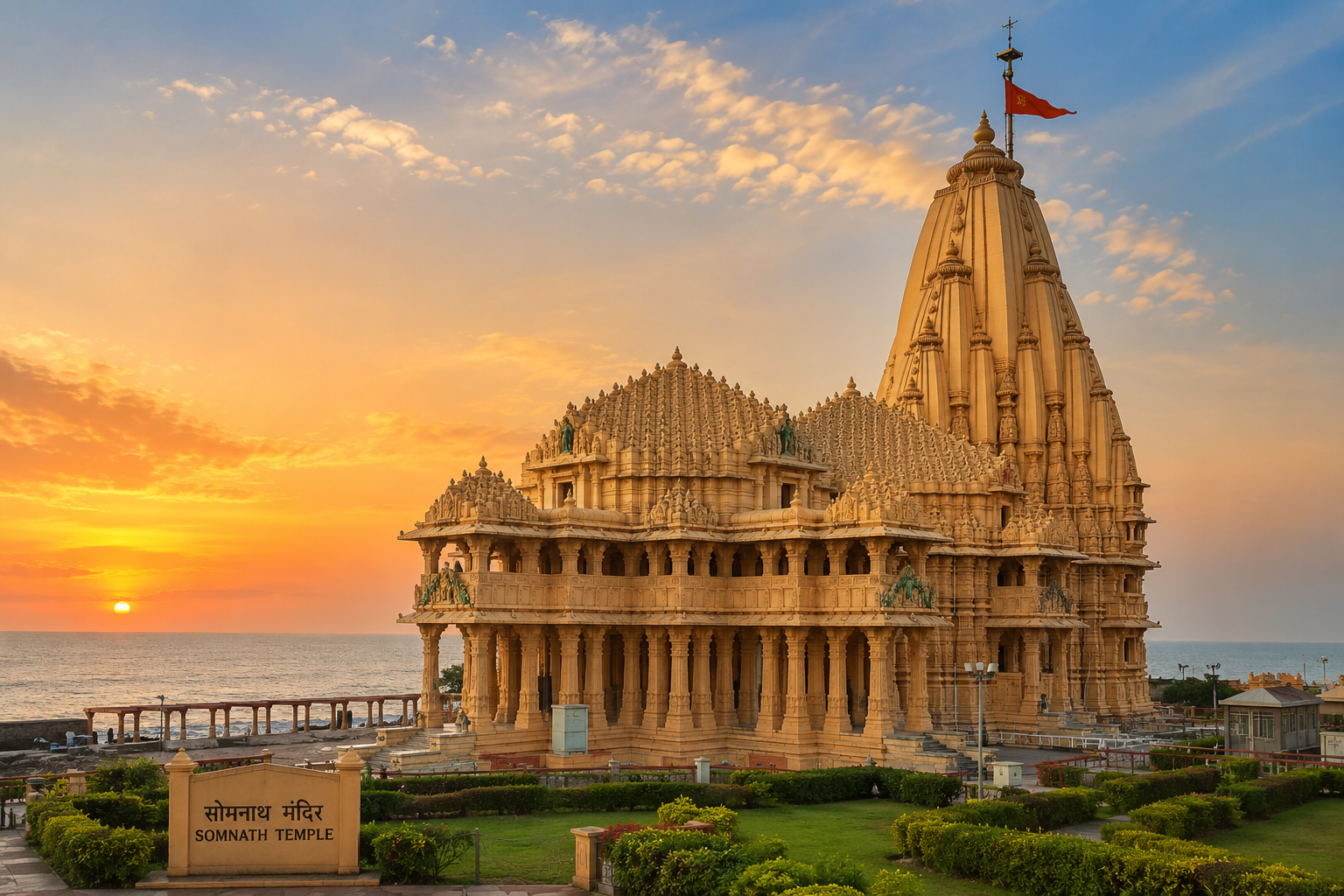
India is currently witnessing a civilizational landmark with the celebration of the Somnath Swabhiman Parv. Observed extensively throughout early 2026, this festival is not merely a religious event but a national commemoration of India’s indomitable spirit. The Somnath Swabhiman Parv marks two pivotal milestones: exactly 1,000 years since the devastating attack by Mahmud of Ghazni in 1026 AD and the 75th anniversary of the temple’s historic Pran-Pratistha in post-independence India (1951).
Under the leadership of Prime Minister Narendra Modi, the Parv has transformed the shores of Prabhas Patan into a global stage for cultural resurgence, shifting the narrative from one of destruction to one of unparalleled “Swabhiman” (Self-Respect).
The Mythology: The “Lord of the Moon”
The name Somnath translates to “Lord of the Moon” (Soma means Moon, Nath means Lord). According to the Skanda Purana, the origin of the temple is tied to a celestial penance:
- The Curse: Chandra (the Moon God) was cursed by Daksha Prajapati to lose his luster for neglecting 26 of his wives in favor of Rohini.
- The Healing: On Brahma’s advice, Chandra performed intense penance to Lord Shiva at the Triveni Sangam (the confluence of the Hiran, Kapila, and Saraswati rivers).
- The Result: Shiva partially lifted the curse, creating the lunar cycle. In gratitude, Chandra built the first temple in gold.
The Seven Reconstructions: A Timeline of Resilience
Historical and archaeological records suggest the temple has been built and rebuilt at least seven times, earning it the title “The Shrine Eternal.”
| Era | Reconstructed By | Material |
| Satya Yuga | Soma (Moon God) | Gold |
| Treta Yuga | Ravana | Silver |
| Dvapara Yuga | Lord Krishna | Sandalwood |
| 649 AD | Vallabhi Kings | Stone/Brick |
| 815 AD | Nagabhata II (Gurjara-Pratihara) | Red Sandstone |
| 1169 AD | Kumarapala (Solanki Dynasty) | Stone & Jewels |
| 1951 AD | Government of India / Trust | Yellow Sandstone |
The Era of Invasions
The Somnath Swabhiman Parv specifically reflects on the 1,000-year mark since the 1026 AD invasion by Mahmud of Ghazni. However, the temple faced repeated challenges:
- 1299 AD: Alauddin Khilji’s general Ulugh Khan looted the shrine.
- 1706 AD: Mughal Emperor Aurangzeb ordered its final major destruction, after which the site remained in ruins for nearly 250 years until India’s independence.
The Modern Revival: Sardar Patel’s Iron Will
The Parv also honors the 75-year journey of the current structure, a miracle of post-1947 diplomacy:
- November 1947: Following the integration of Junagadh, Sardar Vallabhbhai Patel vowed to reconstruct the temple.
- The People’s Temple: Mahatma Gandhi suggested that funds should be raised from the public rather than the state exchequer.
- May 1951: President Dr. Rajendra Prasad performed the Pran-Pratistha, stating that the “creative power of reconstruction is always greater than the destructive power of the sword.”
Read Also: 150 Years of Arya Samaj: Celebrating a Century and a Half of Vedic Renaissance
Major Highlights of the 2026 Somnath Swabhiman Parv
The 2026 celebrations blended ancient rituals with “Viksit Bharat” technology:
- Shaurya Yatra: A “Procession of Bravery” led by PM Modi to honor the protectors of the shrine.
- 3D Laser & Drone Show: Projects the history of the seven reconstructions onto the 155-foot Shikhara.
- 72-Hour Akhand Omkar: Continuous chanting symbolizing the eternal vibration of Indian civilization.
- Baan Stambh (Arrow Pillar): Renewed focus on this southern sea wall pillar, which accurately claims a straight, unobstructed sea route from Somnath to the South Pole (Antarctica).
Conclusion: A Symbol of National Confidence
The Somnath Swabhiman Parv serves as a bridge between India’s heritage (“Virasat”) and its future development (“Vikas”). By celebrating a millennium of survival, the Parv reinforces the message that India’s cultural identity is indestructible. Somnath stands not just as a religious site, but as a beacon of national pride for the “Amrit Kaal.”
Read Also: Strengthening Biosecurity: India’s Role in the Biological Weapons Convention (BWC)
Frequently Asked Questions
What is the Somnath Swabhiman Parv?
It is a 2026 national event marking 1,000 years since the 1026 attack on Somnath and 75 years since its 1951 reconstruction.
Is Somnath the first Jyotirlinga?
Yes, it is revered as the first of the twelve sacred Jyotirlingas of Lord Shiva
What is the architecture style of the Somnath temple?
The current temple is built in the Māru-Gurjara (Chalukya) style of Nagara architecture