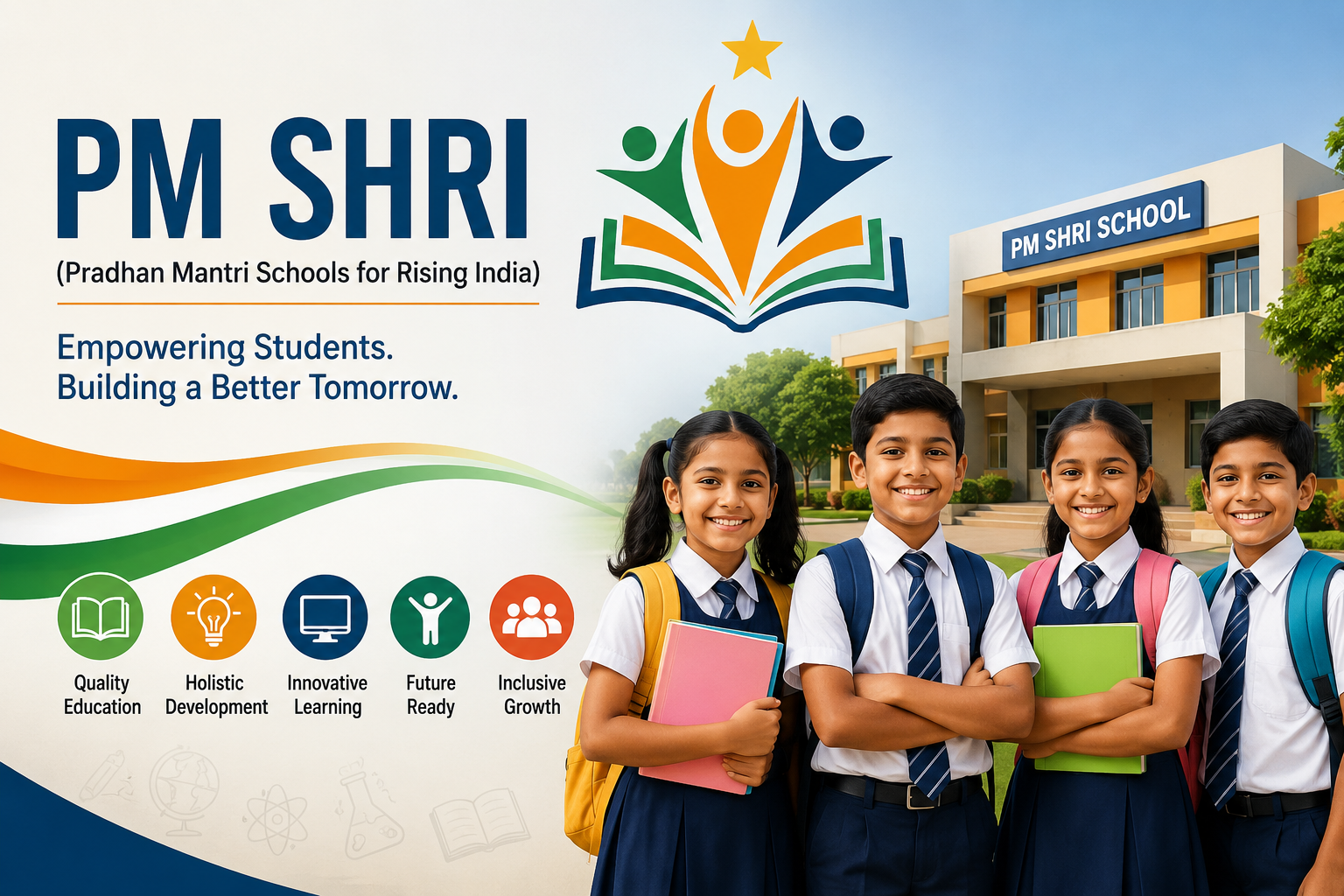
The Ministry of Education (MoE) announced in September 2025 that over 7,500 schools across India have already been upgraded under the Pradhan Mantri Schools for Rising India (PM SHRI) scheme. The government has set an ambitious goal of establishing 14,500 model schools by 2027, ensuring that every child has access to high-quality, future-ready education.
The scheme is being implemented across Central, State, and UT schools, including Kendriya Vidyalayas (KVs) and Jawahar Navodaya Vidyalayas (JNVs). This initiative is a major step in achieving the objectives of the National Education Policy (NEP) 2020 and transforming India’s school education landscape.
PM SHRI Scheme: A Snapshot
Launched on September 7, 2022, the PM SHRI scheme aims to upgrade existing schools into model institutions with modern infrastructure, innovative teaching methods, and holistic development programs.
Key Features of PM SHRI:
- Duration: 2022–23 to 2026–27
- Total Budget: ₹27,360 crore
- Central Share: ₹18,128 crore
- State Share: ₹9,232 crore
- Schools included: Central, State, UT schools, Kendriya Vidyalayas, and Navodaya Vidyalayas
Objectives of PM SHRI
The scheme is designed to:
- Transform schools into benchmarks for NEP 2020 implementation.
- Promote inclusive and equitable education for students of all backgrounds.
- Equip students with 21st-century skills, vocational training, and practical learning experiences.
- Establish strong links with higher education institutions and local industries.
- Ensure students graduate with competency, employable skills, and life skills.
Latest Progress in 2025
- 7,500 schools upgraded: According to MoE, more than 7,500 schools have already been transformed into PM SHRI model schools by the end of 2025.
- Target 2027: The government is on track to meet its goal of 14,500 PM SHRI schools by 2027.
- Coverage: The scheme includes all types of schools—Central, State, UT, Kendriya Vidyalayas, and Navodaya Vidyalayas.
- Infrastructure and Skill Development: Upgraded schools now feature smart classrooms, computer labs, integrated science labs, Atal Tinkering Labs, vocational labs, and modern libraries.
- Digital and Green Initiatives: PM SHRI schools emphasize eco-friendly infrastructure, solar panels, water conservation, waste management, and digital learning tools.
Funding and State Participation
The funding for PM SHRI is shared between the Centre and State governments:
| Entity | Share | Notes |
| Central Government | 60% | Primary contributor |
| State Governments | 40% | Co-funding required |
| North-Eastern States & J&K | 90% Centre / 10% State | Special allocation |
| UTs without Legislature | 100% Centre | Fully funded by Centre |
Several states initially raised concerns about fund-sharing and autonomy, but most have now joined the scheme, including Delhi, Punjab, and Maharashtra, ensuring smooth rollout across the country.
Key Features of PM SHRI Schools
- Inclusive Education: Focused on equitable learning for all students, including Children with Special Needs (CWSN).
- Leadership & Mentorship: PM SHRI schools mentor other regional schools and promote best practices.
- Modern Infrastructure: Smart classrooms, computer labs, science labs, vocational labs, and Atal Tinkering Labs.
- Green Initiatives: Solar panels, nutrition gardens, water conservation, and waste management systems.
- Innovative Pedagogy: Learner-centered, experiential, and competency-based learning.
- Industry Collaboration: Linkages with Sector Skill Councils and local industries for internships and employability.
- School Quality Assessment Framework (SQAF): Continuous monitoring and evaluation to maintain high standards.
Selection and Eligibility
- Eligible Schools: Managed by Central/State/UT governments or local bodies, including KVs and JNVs in permanent buildings.
- Selection Process:
- Schools must have a UDISE+ code and state approval for NEP 2020 implementation.
- Shortlisted schools are inspected by teams from KVs, JNVs, or state authorities.
- Ministry of Education finalizes the selection, maximum two schools per block/urban local body.
- Expert committees take the final decision.
Quality Assurance
PM SHRI schools maintain high educational and operational standards:
- Showcase NEP 2020 implementation.
- Track student enrollment, learning outcomes, and skill acquisition.
- Ensure middle-grade students gain 21st-century skills and secondary-grade students acquire at least one employable skill.
- Link schools with higher education institutions for mentoring and guidance.
- Provide career counseling, psychological support, and holistic development programs.
- Instill Indian heritage, citizenship values, and nation-building responsibilities.
Impact and Outlook
With 7,500 schools already upgraded and the target of 14,500 schools by 2027, PM SHRI is transforming India’s school education system. Students across Central, State, UT schools, KVs, and JNVs are now benefiting from:
- Modern infrastructure and labs
- Inclusive and equitable education
- Green and digital initiatives
- Skill development and vocational training
This initiative ensures that by 2027, millions of Indian students will have access to quality education, employable skills, and holistic development, fulfilling the vision of NEP 2020.
To Download Monthly Current Affairs PDF Click here
Click here to get a free demo
Discover all about CLAT Exam