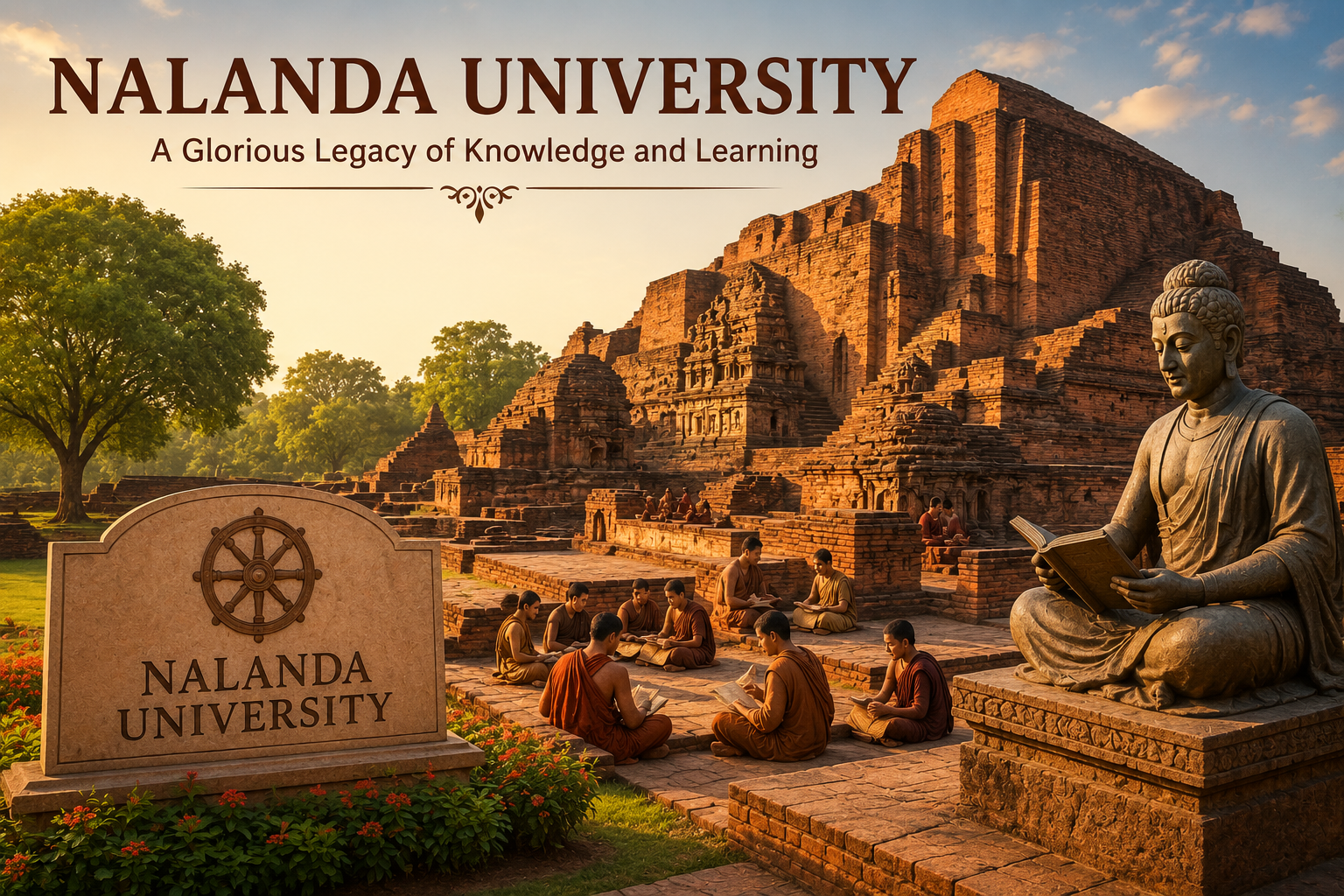
On June 19, 2024, Prime Minister Narendra Modi inaugurated the new Nalanda University campus near the ruins of the ancient Nalanda Mahavihara in Rajgir, Bihar. The grand ceremony was attended by prominent dignitaries, including Governor Rajendra Arlekar, Bihar Chief Minister Nitish Kumar, and Heads of Missions from 17 countries, signaling global commitment to the institution’s renaissance.
The inauguration marked the culmination of a vision first proposed by Dr. APJ Abdul Kalam in 2006, during his address to the Bihar Legislature, where he advocated for the revival of Nalanda as a world-class center for knowledge and peace. Since then, Nalanda University has evolved into a globally supported academic institution rooted in Indian civilizational ethos.
Timeline of Revival: From Idea to Reality
- 2006: Dr. APJ Abdul Kalam proposes reviving Nalanda University.
- 2007: Bihar Assembly passes a bill for the university’s creation; India presents the proposal at the East Asia Summit.
- 2010: Parliament passes the Nalanda University Bill, and the university is officially established on November 25, 2010.
- 2014: First academic session begins.
- 2017: Construction of the permanent campus begins.
- 2024: PM Modi inaugurates the Net Zero campus in Rajgir.
This journey reflects India’s strategic intent to reclaim its soft power heritage while promoting sustainable development and cross-cultural academic exchange.
Ancient Nalanda University: The World’s First Residential University
Established in 427 AD by Kumaragupta I of the Gupta dynasty, ancient Nalanda University was the first international residential university of the world. It attracted scholars from China, Korea, Japan, Sri Lanka, Tibet, and Mongolia. At its peak, the university hosted over 10,000 students and 2,000 teachers, fostering intellectual exchange across Asia.
Key Highlights:
- Nalanda’s curriculum included Buddhism, medicine, mathematics, logic, grammar, astronomy, and Ayurveda.
- Admission was highly competitive and akin to modern Ivy League standards. Students underwent oral interviews by renowned masters like Dharmapala and Silabhadra.
- The university’s library, known as “Dharma Gunj” or “Mountain of Truth,” held 9 million handwritten manuscripts, making it the richest source of Buddhist wisdom in the ancient world.
- Eminent visitors like Xuanzang (Hiuen Tsang) and I-Tsing, Chinese monks and scholars, studied and documented Nalanda’s thriving academic ecosystem.
- Aryabhata, the ancient mathematician and astronomer credited with conceptualizing zero, was associated with Nalanda.
Rise, Fall, and Destruction
Nalanda endured multiple invasions:
- First attack (455–470 AD) by Hunas, countered by Skanda Gupta.
- Second attack in the 7th century by Gour kings of Bengal, amid tensions with Emperor Harshavardhana.
- Final destruction in 1193 AD by Bakhtiyar Khilji, general of Qutbuddin Aibak, who set fire to the vast library. The burning is said to have lasted months.
Despite its tragic end, Nalanda’s legacy shaped Buddhist thought across Asia, with alumni influencing philosophy, metaphysics, logic, and medicine for centuries.
International Support for Modern Nalanda University
The revived Nalanda University is envisioned as an international hub for knowledge diplomacy. Seventeen countries including Australia, China, Bhutan, Sri Lanka, Singapore, South Korea, Laos, and Vietnam have signed MoUs to support the university, both financially and institutionally.
The university’s mission aligns with India’s Act East Policy, deepening cultural and educational ties with Southeast and East Asia. It is also a flagship example of South-South cooperation through ASEAN, BIMSTEC, and the Mekong-Ganga Corridor.
A Green, Net Zero Campus Inspired by the Past
The 455-acre campus is located less than 20 km from the ancient Nalanda ruins and was designed by Padma Vibhushan B.V. Doshi, a legendary architect known for integrating Indian traditions with modern sustainability.
Eco-friendly Features:
- Solar energy plant
- Water recycling and treatment facilities
- 100-acre water bodies for biodiversity
- Sustainable waste management
- A “Net Zero” emissions model, making it one of the greenest university campuses in India
The architecture reflects the Vaastu Shastra principles of the original Nalanda, blending heritage with futuristic design.
Courses and Academic Offerings at Nalanda University
The university offers Postgraduate, Doctoral, and Certificate Programs in fields aligned with its historical mission and global relevance.
Schools and Courses:
- School of Buddhist Studies, Philosophy and Comparative Religion
- School of Historical Studies
- School of Ecology and Environmental Studies
- School of Languages and Literature
Research Centers:
- Center for Bay of Bengal Studies
- Center for Indo-Persian Studies
- Centre for Conflict Resolution and Peace Studies
- Common Archival Resource Center
Scholarships and Global Student Diversity
Nalanda University provides 137 international scholarships, making it a truly global institution. Funding is supported by:
- ASEAN-India Fund
- BIMSTEC scholarships
- Bhutan MEA scholarships
Students come from across Asia, Europe, and Africa, reviving the cosmopolitan ethos of the ancient Nalanda.
Why Nalanda University Matters Today
The revival of Nalanda University is not just an educational project—it’s a civilizational renaissance. In an era of global conflict, climate crisis, and cultural fragmentation, Nalanda serves as:
- A model for ecological and intellectual sustainability
- A platform for interfaith dialogue and peaceful coexistence
- A symbol of India’s knowledge diplomacy and global leadership
Conclusion: Nalanda University – Bridging Civilizations, Past and Future
Nalanda University stands today as a living bridge between ancient wisdom and modern vision. It reclaims India’s historical identity as a global knowledge leader while offering contemporary solutions through education, sustainability, and international cooperation. As it moves forward, Nalanda is poised to become not just a university, but a global lighthouse of learning for generations to come.
To Download Monthly Current Affairs PDF Click here
Click here to get a free demo
Discover all about CLAT Exam