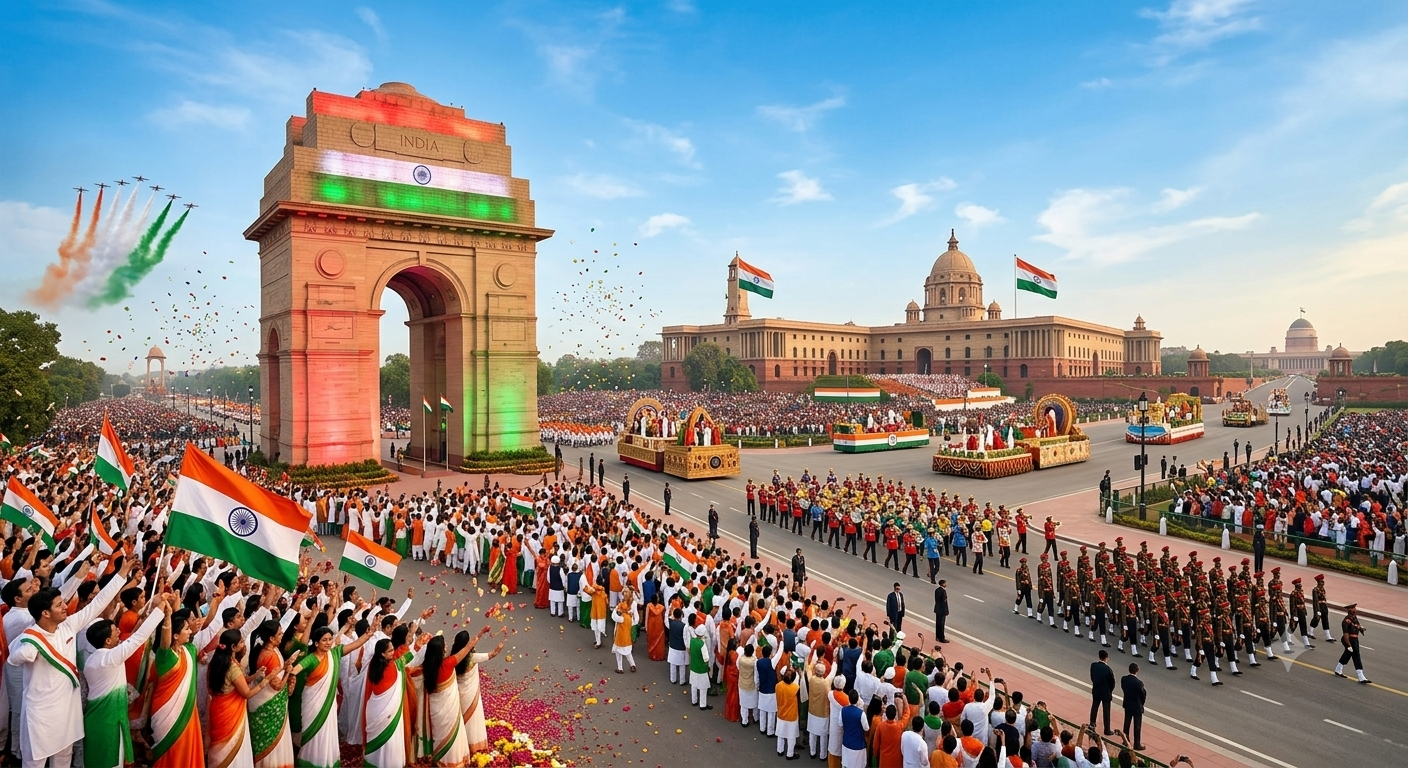
On August 15, 2025, the global community witnessed a historic milestone as the world’s largest democracy celebrated India 79th Independence Day. Marking nearly eight decades since gaining sovereignty from British colonial rule in 1947, the national celebration held at the historic Red Fort in New Delhi showcased a powerful blend of rich heritage and futuristic ambition.
The morning began with a ceremonial Guard of Honour, followed by Prime Minister Narendra Modi hoisting the national flag, assisted by Flying Officer Rashika Sharma. Addressing the nation in a comprehensive 103-minute address, the Prime Minister detailed critical economic milestones, governance reforms, and strategic blueprints aimed at achieving a “Naya Bharat” (New India) by the centenary year of 2047.
Vision 2047: Major Announcements Unveiled
The celebrations for India 79th Independence Day served as a launching pad for several high-stakes national missions spanning employment, defense technology, and clean energy.
PM Viksit Bharat Rozgar Yojana
To empower the nation’s youth, the government announced a massive employment generation initiative targeting the creation of 3.5 crore jobs over the next two years. Under this program, newly employed youth will receive direct financial support of ₹15,000. This initiative is expected to provide structural benefits to nearly 3 crore individuals, steering the national narrative from Swatantra Bharat (Independent India) to Samriddha Bharat (Prosperous India).
Mission Sudarshan Chakra
In a major bid to fortify national security, India officially initiated Mission Sudarshan Chakra. This long-term defense project aims to develop a completely indigenous, Iron Dome-like multi-layered air defense system by 2035. The system is engineered to safeguard critical civilian and strategic assets with advanced interception and retaliation capabilities.
Self-Reliance in Tech: Made-in-India Semiconductor Chips
Advancing the nation’s digital sovereignty, the Prime Minister highlighted that India will produce its very first domestically manufactured semiconductor chip before the end of 2025. Moving forward in mission mode, this development marks a massive shift toward global supply chain independence.
“Samudra Manthan” & Deep Water Exploration
The rollout of the National Deep Water Exploration Mission—codenamed Samudra Manthan—seeks to extensively chart offshore resource bases. The mission will explore deep-sea minerals, oil, and gas to radically scale up long-term energy security.
Economic Reforms & Nuclear Expansion
- Tax Relief: New consumer-friendly GST reforms are scheduled for October 2025, lowering tax burdens on essential goods to aid MSMEs.
- Governance: A specialized Reform Task Force will be established to slash bureaucratic delays, paving the way toward a USD 10 trillion economy.
- Nuclear Scale-up: Plans are underway to expand India’s nuclear energy capability tenfold by 2047, backed by 10 new nuclear reactors currently under development.
Clean Energy Milestone: India achieved its climate target of generating 50% of its cumulative electricity capacity from non-fossil fuel sources five years ahead of its original 2030 deadline.
Timeline of the Indian Freedom Struggle: From Struggle to Sovereignty
The path to the India 79th Independence Day milestone was paved by nearly two centuries of resistance, transitions, and mass movements.
Early Colonial Expansion- 1757–1857
Triggered by British victories at the Battle of Plassey (1757) and Buxar (1764), the East India Company established deep political dominance. Aggressive tax systems like the Permanent Settlement (1793) crippled rural economies and devastated traditional Indian textile industries.
The First War of Independence- 1857
Sparked by intense economic exploitation and military grievances, the Revolt of 1857 united leaders like Rani Lakshmibai and Nana Sahib in a large-scale armed struggle. Though suppressed, it caused the formal transfer of power from the East India Company to the British Crown via the Government of India Act (1858).
The Rise of Organized Nationalism- 1885–1905
Socio-religious reform movements laid the intellectual groundwork for political awakening. In 1885, the Indian National Congress (INC) was founded by Allan Octavian Hume, Dadabhai Naoroji, and W.C. Bonnerjee, initially focusing on constitutional dialogues.
Assertive Nationalism & Partition- 1905–1919
Lord Curzon’s partition of Bengal in 1905 triggered the Swadeshi Movement and mass boycotts of foreign goods. Extremist leaders like the Lal-Bal-Pal triumvirate openly advocated for Swaraj (self-rule), while the Home Rule Movement in 1916 further mobilized public demands for self-governance.
The Gandhian Era & Mass Agitations- 1919–1942
Following the horrific Jallianwala Bagh Massacre (1919), Mahatma Gandhi led historic nationwide movements. This era was defined by the Non-Cooperation Movement (1920–1922), the Civil Disobedience Movement (1930) kicked off by the iconic Dandi Salt March, and the strategic Government of India Act (1935).
The Final Phase & Sovereign Dawn- 1942–1947
Launched in August 1942, the Quit India Movement issued a definitive ‘Do or Die’ call. Simultaneously, Subhas Chandra Bose’s Indian National Army waged military campaigns from abroad. Weakened by World War II, Britain enacted the Mountbatten Plan, culminating in independence and a painful partition on August 15, 1947.
The Evolution of the Indian National Flag
The flag hoisted during the India 79th Independence Day events is the result of decades of symbolic evolution, reflecting changing phases of the resistance movement.
- The Calcutta Flag (1906): One of the earliest unofficial flags, featuring green, yellow, and red horizontal stripes with eight lotuses, a sun, and a crescent moon.
- The Berlin Committee Flag (1907): Designed by Madam Bhikaji Cama and raised in Germany, this version integrated the words “Vande Mataram” in Devanagari script.
- The Swaraj Flag (1921): Visualized by Pingali Venkayya, this flag introduced a central spinning wheel (Charkha) to symbolize economic self-reliance.
- The Final Tricolor (Adopted July 22, 1947): Features Saffron for courage and sacrifice, White for truth and peace, and Green for faith and chivalry. The central Charkha was replaced by the 24-spoke navy blue Ashoka Chakra, signifying righteousness and eternal progress.
Titans of the Freedom Movement
The structural foundation of free India was forged by iconic leaders who utilized diverse strategies to challenge colonial rule.
Mahatma Gandhi
Returning to India in 1915, Mohandas Karamchand Gandhi transformed the independence struggle into a mass movement. By anchoring political resistance in Satyagraha (non-violent resistance) and truth, he united millions across disparate social divides, leaving a lasting legacy of moral and spiritual renewal.
Architects, Revolutionaries, and Pioneers
- Jawaharlal Nehru: A leading diplomatic figure of the struggle who went on to serve as India’s first Prime Minister, championing secularism, industrial planning, and democratic institutionalization.
- Sardar Vallabhbhai Patel: Universally revered as the “Iron Man of India,” his strategic brilliance was instrumental in integrating over 500 princely states smoothly into the modern Indian Union.
- Subhas Chandra Bose: A radical leader who established the Indian National Army (INA) to secure liberation through direct military resistance against British forces during World War II.
- Bhagat Singh & Chandrashekhar Azad: Fearless revolutionary socialists who inspired millions of youths by executing high-profile acts of defiance against colonial infrastructure.
- Rani Lakshmibai: The legendary queen of Jhansi who became an immortal symbol of military valor during the armed uprising of 1857.
- Dr. B.R. Ambedkar: The chief architect of the Indian Constitution who fought passionately for the fundamental rights of Dalits and marginalized groups.
The Power of Underground and Mass Resistance
The narrative of India’s sovereignty is incomplete without the contributions of pioneering women and grassroots organizers who sustained the movement during periods of intense British crackdowns.
| Leader | Key Contribution to the Independence Movement |
| Sarojini Naidu | Known as the “Nightingale of India,” she led major components of the Civil Disobedience Movement and became the first Indian woman INC President. |
| Madam Bhikaji Cama | Championed India’s cause on international platforms and hoisted the first version of the Indian flag on foreign soil in 1907. |
| Aruna Asaf Ali | Famously hoisted the national flag at Gowalia Tank Maidan during the peak of the 1942 Quit India Movement, defying British forces. |
| Usha Mehta | Masterminded the highly secret underground Congress Radio broadcasts, keeping communication alive during periods of heavy censorship. |
| Kamla Nehru | Actively organized mass women-led protests, picketed foreign liquor storefronts, and organized widespread social welfare frameworks. |
To stay fully informed on evolving socio-economic trends, historic policy transformations, and comprehensive international relations updates, check out NewsCanvassEdu.