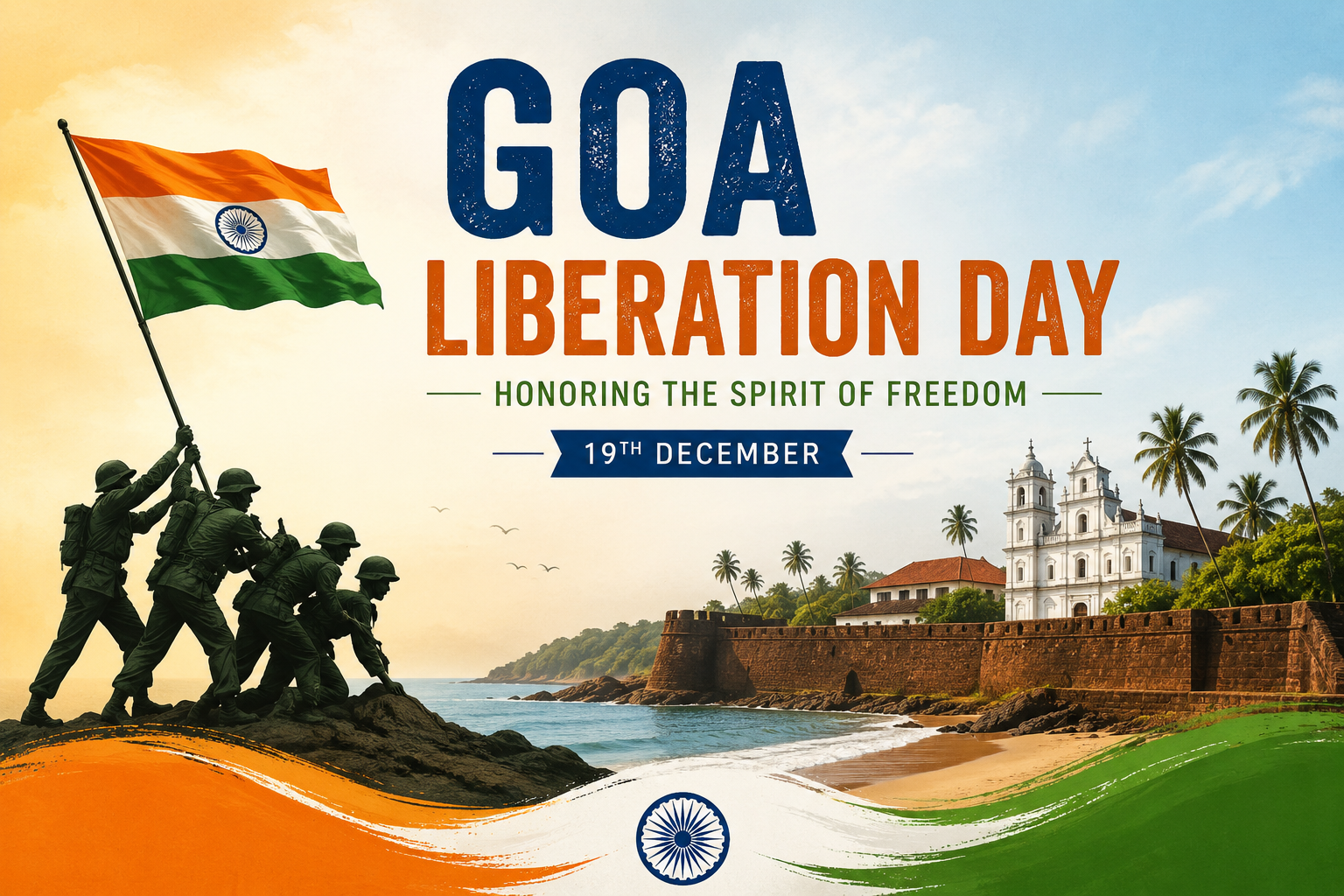
Goa Liberation Day is celebrated on December 19th every year to commemorate the state’s liberation from Portuguese rule in 1961.
Key Points About Goa Liberation Day
- Goa Liberation Day is observed on 19 December every year. It was liberated in 1961 from around 450 years of Portuguese rule
- The day also marked the Indian territory becoming completely free from the European rule.
- Relations between India and Portugal began amicably in 1947 after India’s independence and diplomatic relations were established in 1949.
- Bilateral relations however went into decline after 1950 over Portugal’s refusal to surrender its enclaves of Goa, Daman and Diu and Dadra and Nagar Haveli on India’s west coast.
- Daman & Diu and Dadra and Nagar Haveli were integrated into India in 1961.
- By 1955, the two nations had cut off diplomatic relations, triggering a crisis which precipitated the liberation of Goa by Indian military forces, ending Portuguese rule over Indian enclaves in 1961.
- In 1961, after the failure of diplomatic efforts with the Portuguese, the Indian Government launched Operation Vijay and annexed Daman and Diu and Goa with the Indian mainland on 19th December.
History of Goa’s Liberation Movement
- The Goa liberation movement characterised by revolts and uprisings in the 19th century and non-violent Gandhian methods in the 20th century.
- By the 1940s, the Goan independence movement had gained momentum along with the broader Indian independence movement
- After Indian independence from the British rule in 1947, Portugal and France refused to cede their colonies. Subsequently, India launched a campaign through the UN to persuade both to leave India peacefully.
- Meanwhile, Azad Gomantak Dal carried out raids on police stations and factories and attacked troops. they freed Dadra and Nagar Haveli, a part of Goa, through armed action.
- In addition to these actions, the Satyagraha continued to free Goa from the foreign rule. Nehru, however, buckled under the pressure and denounced the Satyagraha in 1955.
Goa Under Portuguese Rule
- Portuguese governor Afonso de Albuquerque had tried to invade Goa in February 1510 but Albuquerque returned in November 1510, this time with some internal help from Goa, and managed to conquer the portion now known as Old Goa
- Initially, the Portuguese succeeded in getting control over Goa’s northern area. Their expansion was halted by Maratha king Chhatrapati Shivaji in 1664 and later by his son Sambhaji Raje in 1683.
- However, the Portuguese became powerful after Sambhaji Raje’s brutal killing in 1688. They conquered the entire state by 1791.
- The Goa Inquisition, founded by the Portuguese in 1560, has been one of the darkest episodes of Indian history.
- The Inquisition, a judicial system, prosecuted ‘violators’ who followed Hindu or Islamic faith.
- Thousands were allegedly tortured in jails and scores allegedly killed for refusing to convert to Christianity. Speaking Konkani invited punishment. The Inquisition was abolished in 1820 and all records were destroyed.
Operation Vijay
- Ultimately, after the Portuguese didn’t respond to diplomacy, Government of India launched a military operation.
- On 18 and 19 December 1961, Indian troops entered Goa with little resistance and the governor-general of Portuguese India signed an instrument of surrender.
- The 36-hour military operation, conducted from December 18, 1961, was code-named ‘Operation Vijay’ meaning ‘Operation Victory,’ and involved attacks by the Indian Navy, Indian Air Force and Indian Arm
- On 30th May 1987, the territory was split and Goa was formed. Daman and Diu remained a Union Territory. Hence, 30th May is celebrated as the Statehood Day of Goa
Statehood To Goa
- As a result, Goa was brought under the control of the Indian government and became a part of the Indian Union as the Union Territory of Goa, Daman and Diu.
- However, in 1967, a plebiscite was held to determine whether or not the state should merge with Maharashtra and the majority of Goans voted against a merger.
- It remained a Union Territory until 1987, when it was granted statehood. Goa became India’s 25th state, while Daman and Diu remained a Union Territory.
Goa
- Its Official Language is Konkani. Konkani is one of the 22 languages from the Eight Schedule.
- It was added in the list along with Manipuri and Nepali by the 71st Amendment Act of 1992.
- It is surrounded by Maharashtra to the north and Karnataka to the east and south, with the Arabian Sea forming its western coast.
- It is located on the southwestern coast of Indiawithin the region known as the Konkan, and geographically separated from the Deccan highlands by the Western Ghats.
- Goa’s Capital is Panji
- Goa is the smallest state in India. Covering an area of 1,429 square miles, it’s only slightly bigger than Devon, but has a coastline that stretches for 99 miles.
- The state has the highest per capita income in India. Goa is one of India’s wealthiest states
- Goa is home to India’s first printing press and medical school, during the reign of Portuguese, the medical college was set up here in the 18th century. Notably, the college is also one of the oldest medical colleges in Asia today.
- Also, India’s very first printing press started operation in 1956 here when it was brought to St. Paul’s College in Goa. Interestingly, this printing press is also the first-ever in Asia.
List Of Formation Date Of States
| States | Capital | Founded Year | Official Languages |
| Andhra Pradesh | Amaravati, Hyderabad | 1. Nov. 1956 | Telugu |
| Arunachal Pradesh | Itanagar | 20. Feb. 1987 | English |
| Assam | Dispur | 26. Jan. 1950 | Assamese |
| Bihar | Patna | 26. Jan. 1950 | Hindi, Urdu |
| Chhattisgarh | Naya Raipur | 1. Nov. 2000 | Hindi |
| Goa | Panaji | 30. May. 1987 | Konkani, Marathi |
| Gujarat | Gandhinagar | 1. May. 1960 | Gujarati |
| Haryana | Chandigarh | 1. Nov. 1966 | Hindi, Punjabi |
| Himachal Pradesh | Shimla | 25. Jan. 1971 | Hindi, English |
| Jharkhand | Ranchi | 15. Nov. 2000 | Hindi, Urdu |
| Karnataka | Bangalore | 1. Nov. 1956 | Kannada |
| Kerala | Thiruvananthapuram | 1. Nov. 1956 | Malayalam |
| Madhya Pradesh | Bhopal | 1. Nov. 1956 | Hindi |
| Maharashtra | Mumbai | 1. May. 1960 | Marathi |
| Manipur | Imphal | 21. Jan. 1972 | Meitei, English |
| Meghalaya | Shillong | 21. Jan. 1972 | English, Khasi |
| Mizoram | Aizawl | 20. Feb. 1987 | English, Hindi, Mizo |
| Nagaland | Kohima | 1. Dec. 1963 | English |
| Odisha | Bhubaneswar | 26. Jan. 1950 | Odia |
| Punjab | Chandigarh | 1. Nov. 1956 | Punjabi |
| Rajasthan | Jaipur | 1. Nov. 1956 | Hindi, English |
| Sikkim | Gangtok | 16. May. 1975 | English, Bhutia, Gurung, Lepcha, Limbu, Manggar, Mukhia, Newari, Rai, Sherpa, Tamang |
| Tamil Nadu | Chennai | 26. Jan. 1950 | Tamil, English |
| Telangana | Hyderabad | 2. Jun. 2014 | Telugu, Urdu [38] |
| Tripura | Agartala | 21. Jan. 1972 | Bengali, Kokborok, English |
| Uttar Pradesh | Lucknow | 26. Jan. 1950 | Hindi, Urdu |
| Uttarakhand | Dehradun | 9. Nov. 2000 | Hindi, Sanskrit |
| West Bengal | Kolkata | 1. Nov. 1956 | Bengali, Nepali, Hindi, Urdu, Santali, Odia and Punjabi |
| Union territories | |||
| Union territories | Capital | Founded Year | Official Languages |
| Andaman and Nicobar Islands | Port Blair | 1. Nov. 1956 | Hindi, English |
| Chandigarh | Chandigarh | 1. Nov. 1966 | English |
| Dadra and Nagar Haveli | Silvassa | 11. Aug. 1961 | Gujarati, Hindi |
| Daman and Diu | Daman | 30. May. 1987 | English, Gujarati, Hindi, Konkani |
| Delhi | New Delhi | 9. May. 1905 | Hindi, Punjabi, Urdu |
| Lakshadweep | Kavaratti | 1. Nov. 1956 | English, Hindi |
| Puducherry | Pondicherry | 1. Nov. 1954 | English, Tamil, Malayalam, Telugu |
| Jammu and Kashmir | Srinagar (Summer), Jammu (Winter) | From 31 Oct 2019 | Urdu |
| Ladakh | Leh | From 31 Oct 2019 | Bhoti |
To Download Monthly Current Affairs PDF Click here
Click here to get a free demo
Everything About CLAT 2026