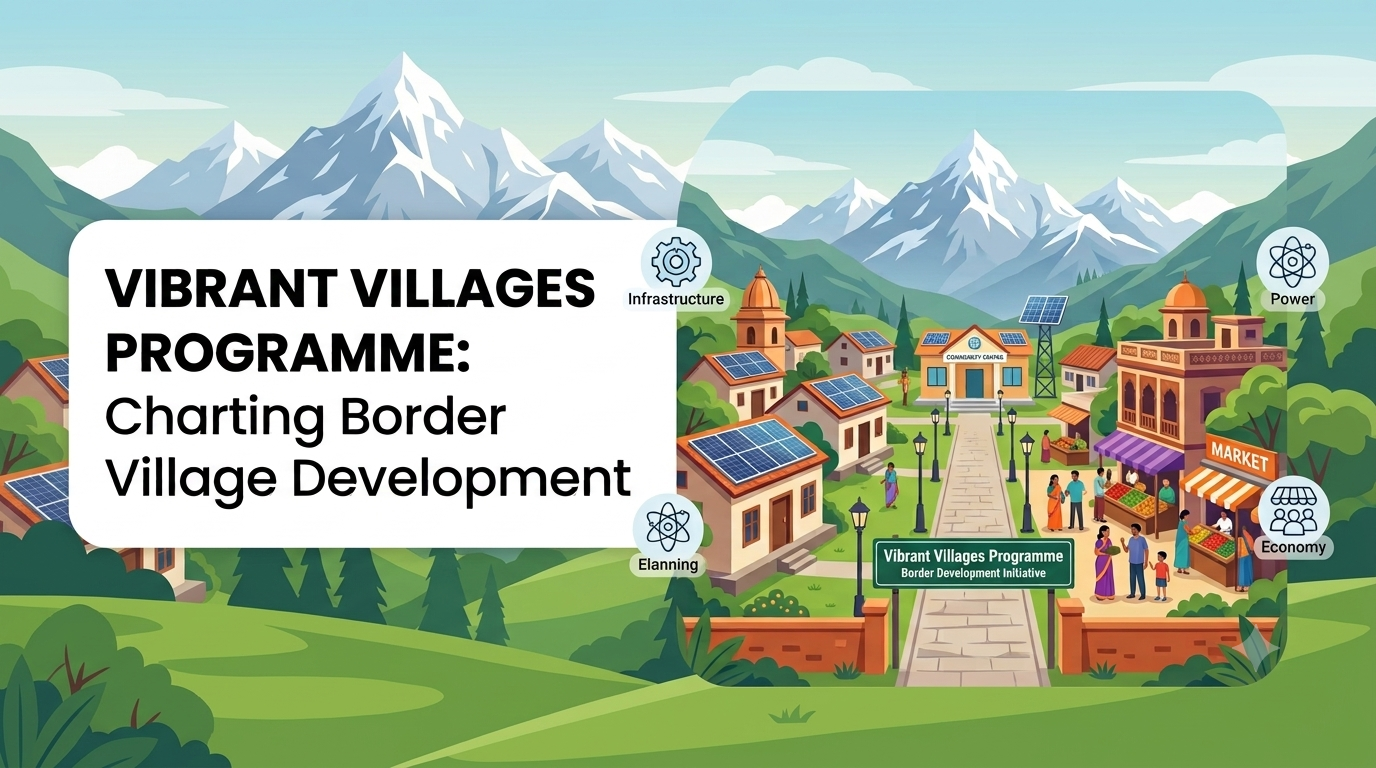
The Vibrant Villages Programme has entered a new chapter. The Union Cabinet has approved Vibrant Villages Programme Phase II (VVP-II), extending the scheme to cover villages along all of India’s international land borders — not just the China border, as in Phase I. With a fresh outlay of ₹6,839 crore, the Vibrant Villages Programme is now central to India’s strategy of turning remote, underdeveloped border settlements into thriving, secure, and economically vibrant communities. Here’s everything you need to know about the Vibrant Villages Programme, answered in simple Q&A format.
What Are the Key Takeaways of the Vibrant Villages Programme?
- Vibrant Villages Programme Phase II has a total outlay of ₹6,839 crore, running through FY 2028-29.
- Unlike VVP-I (China-border focused), VVP-II covers all international land borders, spanning 17 states/UTs.
- It is a 100% Centrally funded (Central Sector) scheme — no state cost-sharing.
- VVP combines infrastructure, livelihoods, security, and cultural integration to transform border villages.
- As of 2025, VVP has delivered 113 roads, 8 bridges, 4G in 362 villages, and electrification of 601 villages.
- VVP evolved from the older Border Area Development Programme (BADP), shifting from state-level infrastructure gaps to village-level, security-integrated strategic development.
- The programme mirrors — and responds to — China’s “Xiaokang” border village model, which uses civilian settlements for territorial and military consolidation.
- VVP aligns with India’s Viksit Bharat@2047 vision for secure, self-sufficient borders.
What Is the Vibrant Villages Programme?
The Vibrant Villages Programme (VVP) is a Government of India scheme, run by the Ministry of Home Affairs, aimed at transforming India’s border villages from neglected, underdeveloped outposts into strategic assets for both development and national security. It does this by combining infrastructure development, livelihood generation, and cultural integration with a security objective: a thriving civilian population in border areas, acting as a “human shield” and as the “eyes and ears” of security forces against infiltration and trans-border crime.
When Was the Vibrant Villages Programme Launched, and What Does Phase II Add?
The Vibrant Villages Programme was first announced in the Union Budget 2022–23 and launched in 2023 with an initial outlay of ₹4,800 crore for 2022–23 to 2025–26, focused specifically on villages along the China border.
Vibrant Villages Programme Phase II (VVP-II) marks a major expansion:
- Total outlay: ₹6,839 crore
- Duration: Through FY 2028-29
- Coverage: All international land borders, not just China — a direct strategic widening of the original scheme
What Are the Objectives of the Vibrant Villages Programme?
The Vibrant Villages Programme follows a multidimensional approach built around five core objectives:
- Infrastructure Development — roads, telecom, internet, renewable energy, drinking water, healthcare, and education
- Livelihood Generation — agriculture, horticulture, tourism, local crafts, and rural entrepreneurship
- Cultural and Social Integration — heritage promotion, festivals, and eco-tourism to build community pride
- Security Enhancement — sustaining a civilian population in sensitive border zones as a buffer and support base for security forces
- Outcome-Oriented Monitoring — measurable results tracked at the village, household, and individual level
Which States Are Covered Under Vibrant Villages Programme Phase II?
VVP-II will be implemented in selected villages across 17 states and Union Territories: Arunachal Pradesh, Assam, Bihar, Gujarat, Jammu & Kashmir, Ladakh, Manipur, Meghalaya, Mizoram, Nagaland, Punjab, Rajasthan, Sikkim, Tripura, Uttarakhand, Uttar Pradesh, and West Bengal. This is a major expansion from Phase I, which was limited to villages along the China border.
What Are the Key Components of the Vibrant Villages Programme?
The Vibrant Villages Programme is built around several development pillars:
- Village/cluster-level infrastructure
- Value chain development through cooperatives and Self Help Groups (SHGs)
- SMART classrooms and educational infrastructure
- Border-specific outreach and tourism circuit development
- Promotion of sustainable and diverse livelihoods
- All-weather road connectivity under PMGSY-IV
- Four thematic connectivity areas: roads, telecom, television access, and electrification
- Village Action Plans (VAPs), prepared collaboratively and overseen by a Cabinet Secretary-led High-Powered Committee
- Cultural integration through fairs, festivals, awareness camps, and regular ministerial visits to boost tourism and local heritage
How Does the Vibrant Villages Programme Strengthen Border Security?
The Vibrant Villages Programme treats civilian presence itself as a security strategy. Key mechanisms include:
- Civilian presence as a security buffer — retaining population in border villages discourages foreign encroachment and reinforces territorial claims
- Population as the “eyes and ears” of the state — locals assist security forces in curbing trans-border crime, smuggling, and illegal crossings
- Integrated development and security — infrastructure (roads, telecom/5G, energy, healthcare) is paired with livelihoods to make border regions both economically dynamic and strategically secure
- Technology-driven governance — optical fiber, PM Gati Shakti, and DBT-linked welfare schemes support transparent, real-time monitoring and geo-tagging of assets
This integrated approach is part of India’s broader geostrategic response to rising border threats, particularly from China, and aligns with the Viksit Bharat@2047 vision for safe, secure, and self-sufficient borders.
What Progress Has the Vibrant Villages Programme Made So Far (2025)?
By 2025, the Vibrant Villages Programme had recorded measurable progress:
Infrastructure:
- ₹2,400 crore invested in 113 roads and 8 low-suspension bridges
- 362 villages now have 4G connectivity (as of June 2025)
- 474 villages electrified on-grid and 127 off-grid (out of 662 targeted), via 43 new power projects worth ₹238 crore
- 570 previously unbanked villages (out of 662) now linked to banking facilities
Livelihoods and Economy:
- 901 employment-related projects initiated to generate local jobs and curb outmigration
- ₹556 crore in schemes for agriculture, education, health, energy, cooperatives, and Khadi and Village Industries
- 102 tourism projects — View Points, Adventure Tourism, Eco-Resorts, and Tourist Centres — implemented at a cost of ₹48 crore
How Does the Vibrant Villages Programme Differ from BADP?
The Vibrant Villages Programme evolved from the older Border Area Development Programme (BADP), launched in 1986-87, which focused on basic infrastructure gaps in 15 border states within a 0–10 km zone of the international boundary. BADP was criticized for scattered implementation, lack of a central strategic framework, and weak integration with security planning.
| Aspect | BADP | Vibrant Villages Programme |
| Objective | Infrastructure gaps | Strategic border development |
| Planning Unit | State-level | Village-level (cluster approach) |
| Monitoring | Basic reports | Real-time, data-driven, third-party evaluated |
| Security Integration | Weak | Strong — civilian presence as a security buffer |
| Funding Type | Centrally Sponsored | Central Sector (100% Centre-funded) |
This shift makes the Vibrant Villages Programme a far more targeted, security-conscious, and outcome-driven successor to BADP.
How Does China’s Border Village Model Compare to India’s Vibrant Villages Programme?
China runs a parallel — and in some ways competing — border village strategy that helps explain the urgency behind India’s Vibrant Villages Programme. China’s model centers on:
- “Xiaokang” (well-off) villages — over 600 built since 2017 along the Line of Actual Control (LAC) in the Tibet Autonomous Region, with plans for 628 villages (427 first-line, 201 second-line) from Ngari to Nyingchi
- Civil-military fusion — infrastructure like roads, airfields, and villages serve both economic and PLA/PAP defense functions
- Legal backing via China’s Land Border Law (2022), which mandates local governments to secure border regions and support military operations
- Gray zone tactics — increasing civilian presence to create “facts on the ground” that strengthen territorial claims and complicate border negotiations
- Integration with China’s National Rural Revitalization Programme (2018–2035)
India’s Vibrant Villages Programme is widely seen as a strategic counter to this model — using a similar civilian-settlement approach but framed around development, livelihoods, and voluntary national integration rather than dual-use military fusion.
What Other Schemes Support India’s Border Areas Alongside the Vibrant Villages Programme?
The Vibrant Villages Programme operates alongside several complementary border management schemes:
- Border Infrastructure and Management (BIM) Scheme — ₹13,020 crore outlay (2021-22 to 2025-26) for fencing, floodlighting, roads, Border Outposts, and surveillance tech; Budget 2025-26 allocation rose 32.89% to ₹5,597.25 crore
- Comprehensive Integrated Border Management System (CIBMS) — sensors, radars, CCTV, smart fencing, anti-drone systems, and tunnel detection, with full electronic surveillance of the India-Pakistan border planned within four years
- Integrated Check Posts (ICPs) — modern customs, immigration, and trade infrastructure at major border crossings
- Border Roads Organisation (BRO) projects — strategic roads and tunnels like Atal Tunnel, Zojila Tunnel, and Sela Tunnel
- Fencing projects along the India-Pakistan and India-Bangladesh borders
- PMGSY-IV, Digital India, Jal Jeevan Mission, Saubhagya, Skill India, and PMKVY — supporting connectivity, amenities, and employment in border regions
What Is the Future Outlook for the Vibrant Villages Programme?
With VVP-II extending coverage to all international land borders through FY 2028-29, the Vibrant Villages Programme is set to scale significantly beyond its China-border origins. Continued convergence with schemes like CIBMS, BIM, and PMGSY-IV, along with real-time monitoring and geo-tagging, suggests the programme will increasingly function as an integrated border-development backbone — balancing economic upliftment with India’s long-term security posture along all its frontiers.
To monitor the continuous evolution of digital governance, financial frameworks, and macro-economic policy updates in India, explore the NewsCanvassEdu platform.