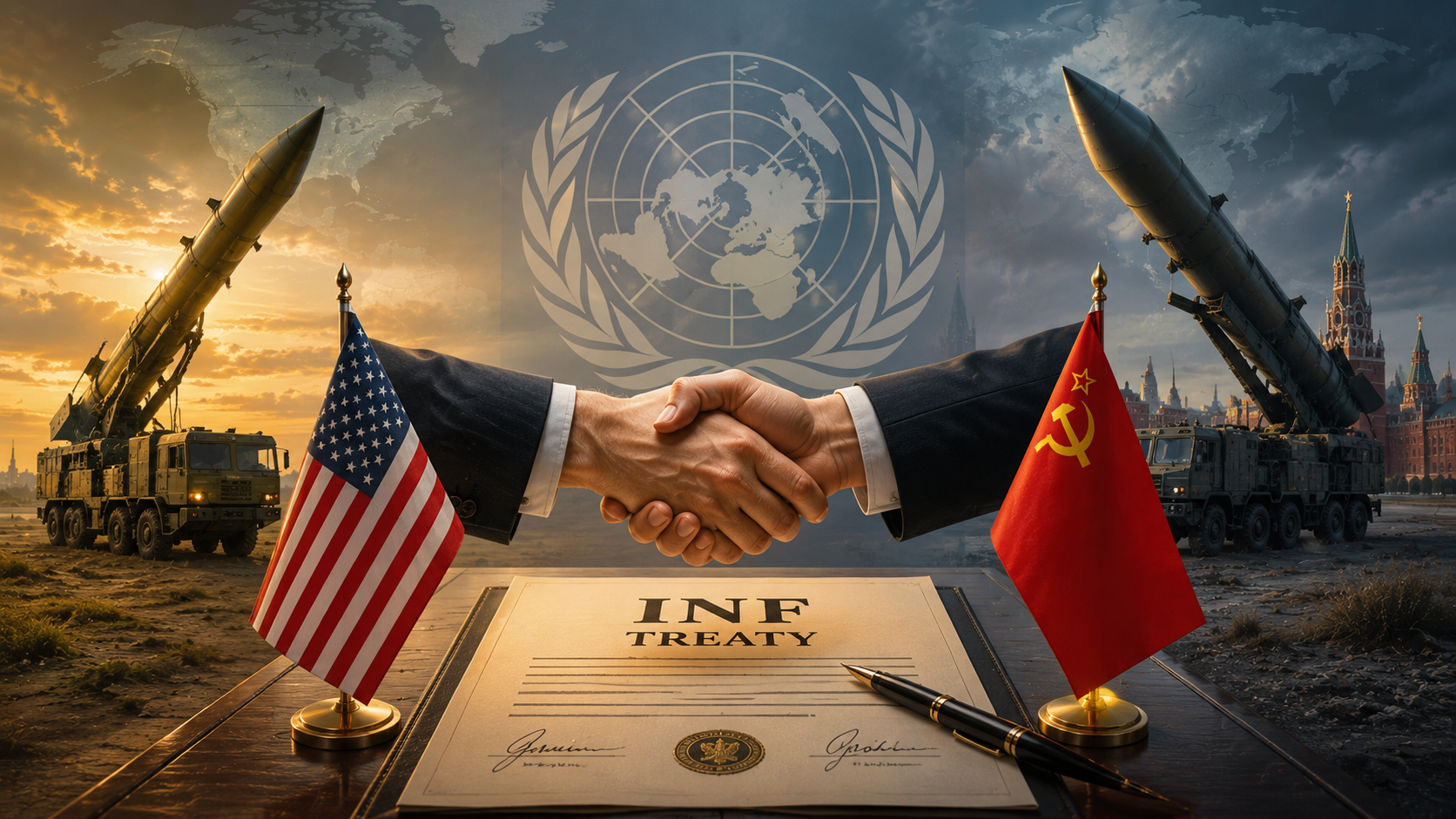
The INF Treaty — once a cornerstone of Cold War-era nuclear stability — is now officially history. Russia has formally withdrawn from the 1987 Intermediate-Range Nuclear Forces (INF) Treaty, six years after the United States exited the same agreement. This guide breaks down everything you need to know about the INF Treaty: what it banned, why it collapsed, and what its end means for global security, in a simple Q&A format.
What Are the Key Takeaways of the INF Treaty’s Collapse?
- The INF Treaty was signed in 1987 by Reagan and Gorbachev and entered into force in 1988, banning ground-launched missiles with ranges of 500–5,500 km.
- It led to the verified destruction of 2,692 missiles by 1991 — the first treaty to eliminate an entire class of weapons.
- The US withdrew from the INF Treaty in August 2019, citing Russia’s deployment of the SSC-8 (9M729) missile.
- Russia formally withdrew from the INF Treaty as well, citing US withdrawal, missile deployments in Asia/Europe, and unrestricted missile programs in China, North Korea, India, Pakistan, and Iran.
- The collapse of the INF Treaty raises the risk of a new arms race, weakens European security, and erodes the broader nuclear non-proliferation architecture.
- It coincides with the rise of hypersonic weapons and expanding missile defense systems, reshaping global deterrence — including India’s own nuclear doctrine.
- The only remaining US–Russia arms control treaty, New START, is set to expire in 2026 unless extended.
What Is the INF Treaty and When Was It Signed?
The INF Treaty (Intermediate-Range Nuclear Forces Treaty) was signed on December 8, 1987, by US President Ronald Reagan and Soviet leader Mikhail Gorbachev, entering into force on June 1, 1988. It was the first arms control agreement to abolish an entire class of deployed weapon systems. The treaty grew out of Cold War tensions in Europe, triggered by the Soviet Union’s deployment of SS-20 missiles and the US response with Pershing II and Tomahawk missiles. Years of public protest and diplomacy eventually led to the US “zero option” proposal — calling for total removal of these weapons — which became the foundation of the INF Treaty.
What Did the INF Treaty Promise to Eliminate?
Under the INF Treaty, both the US and USSR were required to eliminate and permanently forswear all nuclear and conventional ground-launched ballistic and cruise missiles with ranges between 500 and 5,500 km — covering both intermediate-range (1,000–5,500 km) and shorter-range (500–1,000 km) systems.
Missiles destroyed under the INF Treaty included:
- United States: Pershing II, Pershing IA, Pershing IB, and BGM-109G cruise missiles
- Soviet Union: SS-20, SS-4, SS-5, SS-12, SS-23, and SSC-X-4 cruise missiles
The INF Treaty also banned functional equivalents of prohibited systems — for instance, placing banned missiles on ships was not allowed — though it notably did not cover sea-launched or air-launched missiles. Shorter-range missiles had to be eliminated within 18 months of entry into force, and intermediate-range missiles within 36 months.
What Verification Measures Did the INF Treaty Include?
The INF Treaty introduced some of the most rigorous verification mechanisms of its time, including:
- On-site inspections at missile bases and production facilities
- Baseline data exchanges on missile inventories and deployment locations
- Continuous monitoring during elimination procedures
- Short-notice inspections, gradually reduced in frequency over the years
By 1991, these mechanisms had verified the destruction of 2,692 missiles — 1,846 Soviet and 846 US — along with their launchers, removing an entire category of nuclear threat from Europe and setting a precedent for future arms reduction deals.
Why Did the INF Treaty Collapse?
The INF Treaty’s collapse unfolded over several years of accusations and counter-withdrawals from both sides.
Why Did the US Withdraw from the INF Treaty?
The United States accused Russia of violating the INF Treaty by developing and deploying the SSC-8 (9M729) ground-launched, intermediate-range cruise missile, arguing it breached the treaty’s range limits. After repeated diplomatic efforts failed — with Moscow denying the allegations — the US issued a formal withdrawal notice in February 2019 and officially exited the INF Treaty on August 2, 2019.
Why Did Russia Withdraw from the INF Treaty?
Russia responded with what it called a “mirror response,” suspending participation and blaming the US exit as the real cause of the treaty’s collapse. Russia’s formal withdrawal from the INF Treaty was further justified by:
- A changing global security environment, with countries like China, North Korea, India, Pakistan, and Iran building intermediate-range missile systems without any treaty restrictions
- The belief that the INF Treaty put Russia at a strategic disadvantage while others expanded freely
- US deployment of Typhon missile systems in the Philippines and missile drills in Australia (Talisman Sabre exercises), which Moscow viewed as platforms that could host intermediate-range missiles and threaten Russian security
What Are the Consequences of the INF Treaty’s Collapse?
The end of the INF Treaty carries several major consequences:
- Renewed arms race risk: Both the US and Russia are now free to develop and deploy intermediate-range missiles, with other states likely to follow, raising fears of a new Cold War-style arms race with faster, more destabilizing weapons.
- Weaker European security: The INF Treaty had prevented missile deployments capable of striking NATO countries within minutes; its collapse raises fresh concerns about escalation near NATO borders.
- Erosion of arms control regimes: The treaty’s demise undermines the broader nonproliferation architecture and complicates future negotiations, including on extending New START.
- New technology risks: The collapse coincides with the rise of hypersonic weapons and advanced missile defense systems, making it harder to bring emerging threats under any arms control framework.
- Deteriorating US–Russia relations: The end of the INF Treaty reflects and accelerates the broader decline in US–Russia relations, reducing avenues for cooperation across other areas of global diplomacy.
How Does the INF Treaty Compare to Other Nuclear Arms Control Treaties?
The INF Treaty is one of several major nuclear arms control milestones:
| Treaty | Year | Focus |
| Non-Proliferation Treaty (NPT) | 1970 | Prevents spread of nuclear weapons; rests on non-proliferation, disarmament, and peaceful use pillars |
| ABM Treaty | 1972 (US exited 2002) | Limited missile defense systems to preserve mutually assured destruction |
| SALT I & II | 1972, 1979 | Capped strategic launchers and MIRVs |
| INF Treaty | 1987–2019/Russia’s exit | Eliminated ground-launched missiles with 500–5,500 km range |
| START I, II, New START | 1991, 1993, 2010 | Reduced deployed strategic warheads and launchers; New START caps at 1,550 warheads, expiring 2026 |
| CTBT | 1996 | Bans all nuclear test explosions; not yet in force |
| TPNW | 2017 | First treaty seeking total prohibition of nuclear weapons; no nuclear-armed state has joined |
Unlike the NPT or CTBT, the INF Treaty was a bilateral US–Soviet/Russian agreement, which is part of why its collapse so directly affects the US–Russia strategic balance rather than the global non-proliferation regime as a whole.
How Does India’s Nuclear Doctrine Relate to the INF Treaty’s Collapse?
India was never a party to the INF Treaty, but the treaty’s collapse has direct strategic implications for India. India’s nuclear doctrine, adopted in 2003, is built around:
- No First Use (NFU): India will not use nuclear weapons first, retaliating only against a nuclear attack — a pledge that extends to chemical and biological attacks as well
- Credible Minimum Deterrence: A limited arsenal backed by a nuclear triad (land, air, and sea-based systems) for second-strike capability
- Massive Retaliation: Any nuclear attack triggers a massive, disproportionate response
- Non-use against non-nuclear states
- Civilian-controlled command through the Nuclear Command Authority, led politically by the Prime Minister
With the INF Treaty gone and countries like China expanding intermediate-range and hypersonic missile arsenals, India faces a recalibrated two-front nuclear challenge from China and Pakistan, pushing it to strengthen deterrence through programs like the Hypersonic Technology Demonstrator Vehicle (HSTDV) and advanced Agni missile variants.
What Is the Post-INF Treaty World Bringing — Hypersonic Weapons and Missile Defense?
The fall of the INF Treaty has coincided with rapid advances that are reshaping global deterrence:
- Hypersonic weapons: Russia has operationalized the Avangard hypersonic glide system, and China has advanced the DF-17 — both capable of bypassing traditional missile defenses
- Expanding missile defense: The US has expanded systems like Aegis and THAAD, which adversaries view as potentially undermining nuclear deterrence and prompting further arms buildups
- Regional ripple effects: China’s missile superiority and US deployments in the Asia-Pacific add to tensions, while India develops its own hypersonic capabilities through DRDO and ISRO to maintain a credible deterrent
What’s the Future Outlook After the INF Treaty?
With the INF Treaty now defunct on both sides, the global arms control landscape looks increasingly fragile. New START, the only remaining US–Russia arms control treaty, is set to expire in 2026 unless extended — and its future is clouded by the same trust deficit that ended the INF Treaty. Meanwhile, the unrestricted missile programs of non-treaty states (China, North Korea, India, Pakistan, Iran) mean any future intermediate-range missile framework would likely need to be multilateral rather than bilateral, a far more complex diplomatic undertaking.
To monitor ongoing diplomatic shifts, bilateral defense treaties, and regional economic breakthroughs across the Indo-Pacific, visit NewsCanvassEdu.