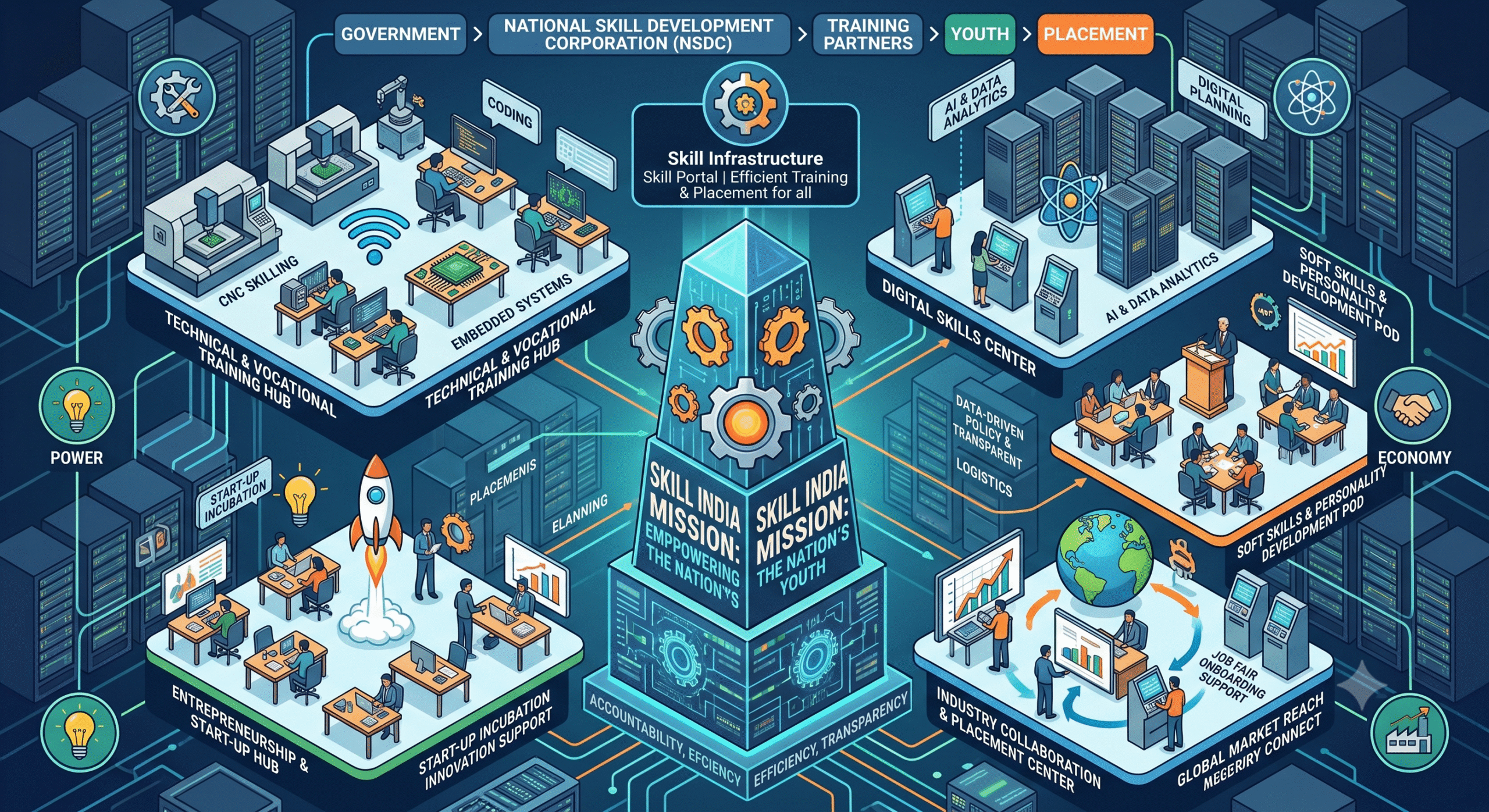
The global race for industrial dominance and economic sovereignty requires more than infrastructure; it demands a highly capable, certified workforce. To address this structural challenge, the Government of India launched the Skill India Mission, formally known as the National Skills Development Mission of India. Launched on July 15, 2015, by Prime Minister Narendra Modi, the initiative’s debut coincided with the inaugural World Youth Skills Day.
Managed under the strict oversight of the Ministry of Skill Development & Entrepreneurship (MSDE) and executed by the National Skills Development Corporation of India (NSDC), the Skill India Mission stands as a monumental infrastructure layout designed to scale up vocational capability, drive gender-inclusive employment, and transition India into a global human resource powerhouse.
Why India Needed the Skill India Mission
The core driver behind the launch of the Skill India Mission was a historic deficit in formal vocational training across the domestic labor pool. A foundational baseline report from 2014 revealed a stark reality: only about 2% of the Indian workforce had received formal skills training.
This created a severe roadblock for an economy undergoing rapid industrialization and globalization. While traditional and emerging sectors faced an immediate demand for technical hands, a massive segment of educated youth faced chronic underemployment due to a distinct mismatch between conventional academic qualifications and industry requirements.
| Country | Percentage of Formally Skilled Workforce (2014 Baseline) |
| South Korea | 96% |
| Japan | 80% |
| Germany | 75% |
| United Kingdom | 68% |
| India | 2% |
Structural Framework: What the Skill India Mission Set Out to Achieve
To bridge these profound macro-level skill gaps, the Skill India Mission established clear operational targets:
- Market-Relevant Training Execution: Empowering youth from diverse socio-economic backgrounds with certified trade capabilities that directly translate into wage employment.
- Dual-Sector Curricula Prototyping: Providing comprehensive instruction that balances traditional fields (such as carpentry, tailoring, weaving, and nursing) with fast-evolving, high-tech sectors.
- Enhanced Industrial Relevancy: Shifting the educational focus away from purely rote memorization toward standardized hands-on apprenticeships, institutional on-the-job training (OJT), and globally recognized certifications.
- Public-Private Partnerships (PPPs): Actively mobilizing corporate investments, industry associations, and non-governmental organizations to design curricula that mirror live marketplace demands.
A New Chapter: Restructuring the Skill India Mission (2022–2026)
To optimize delivery and streamline fiscal resource deployment, the Union Cabinet approved a fully restructured iteration of the Skill India Mission to run through March 2026. This layout features a dedicated financial outlay of ₹8,800 crore spanning the 2022–23 to 2025–26 fiscal timeframe.
The primary structural update consolidates three major independent operations into a single, cohesive Central Sector Scheme:
- Pradhan Mantri Kaushal Vikas Yojana 4.0 (PMKVY 4.0): The primary driver for modern tech-enabled institutional skilling across industrial sectors.
- Pradhan Mantri National Apprenticeship Promotion Scheme (PM-NAPS): The targeted vehicle for expanding formal on-the-job training opportunities and employer incentives.
- Jan Shikshan Sansthan (JSS) Scheme: The localized community network offering vocational skills to non-literate and marginalized demographics.
Flagship Schemes Driving the Skill India Mission
The everyday operations of the Skill India Mission are powered by targeted sub-schemes that address specific demographics and training styles:
Pradhan Mantri Kaushal Vikas Yojana 4.0 (PMKVY 4.0)
As the absolute flagship vehicle of the Skill India Mission, PMKVY 4.0 focuses on making the training framework demand-driven and tech-enabled. It delivers short-term, industry-aligned training in emerging Fourth Industrial Revolution domains such as Artificial Intelligence (AI), robotics, 3D printing, coding, and green jobs.
Crucially, PMKVY 4.0 integrates a Recognition of Prior Learning (RPL) process to formally certify individuals with informal pre-existing talents, enabling seamless upskilling. By mid-2025, over 1.63 crore candidates had been successfully trained under the PMKVY umbrella across the manufacturing, healthcare, IT, and construction sectors.
Pradhan Mantri National Apprenticeship Promotion Scheme (PM-NAPS)
PM-NAPS drives direct industry integration by offering financial incentives to employers who provide structured on-the-job training. This initiative has successfully expanded formal apprenticeship programs into advanced technical ecosystems, including drone technology training within Industrial Training Institutes (ITIs). By May 2025, PM-NAPS had engaged over 43.47 lakh apprentices across 36 States and Union Territories.
Jan Shikshan Sansthan (JSS) Scheme
Operating through community-based institutes in rural and low-income urban localities, the JSS scheme delivers non-formal vocational training specifically customized for non-literates, school dropouts, women, and historically marginalized communities (SC/ST/OBC/minorities). Between FY 2018–19 and FY 2023–24, the JSS network successfully trained over 26 lakh individuals, driving localized self-employment and micro-enterprise creation.
Technical and Operational Reforms in Learning
The Skill India Mission has systematically dismantled outdated vocational pathways by implementing key operational updates:
- Utilization of Existing Infrastructure: To maximize fiscal efficiency, training modules utilize existing infrastructure during off-hours across public schools, colleges, universities, and private corporate facilities.
- Whole-of-Government Coordination: A cross-ministerial framework links various state and federal departments to prevent redundancy in trade certifications.
- National Credit Framework (NCrF) Alignment: All courses are mapped to the National Skills Qualification Framework (NSQF). This enables transparent credit accumulation, allowing learners to transition smoothly between vocational training, formal higher education, and active employment.
Impact and Milestones of the Skill India Mission
The long-term execution of the Skill India Mission has delivered measurable macro-economic turnarounds:
Broad Training Milestones
The mission has successfully provided standardized training to over 6 crore (60 million) individuals across 38 diverse industrial sectors. This scale has contributed to a steady increase in graduate employability, which rose to 54.81% by 2025, alongside an expansion of India’s overall national employment rate from 36.9% in 2015 to 37.9% in 2025.
Sector-Specific Growth Attributed to Skill India Mission Interventions
- Construction Sector: 25% growth
- Services Sector: 20% growth
- Manufacturing Sector: 15% growth
Digital Infrastructure and the Skill India Digital Hub (SIDH)
The deployment of the Skill India Digital Hub (SIDH) created a centralized, secure digital ledger for the entire ecosystem. SIDH provides verification of qualifications, tracks individual learning pathways, and integrates with DigiLocker to issue verifiable digital credentials.
The Skilling for AI Readiness (SOAR) Initiative
Anticipating the technological demands of the future, the mission rolled out the SOAR initiative. This program introduces foundational AI literacy directly at the school level, positioning India as an early pioneer in secondary-level 21st-century digital competencies.
Supporting Allies in the National Skilling Story
The overarching objectives of the Skill India Mission are heavily supported by concurrent specialized operations:
- Rural Self Employment and Training Institutes (RSETIs): A bank-led, residential training infrastructure that focused heavily on micro-enterprise development; it successfully crossed 5.67 million trained candidates by mid-2025.
- Deen Dayal Upadhyaya Grameen Kaushalya Yojana (DDU-GKY): A placement-linked, wage-employment focused skill program targeting rural youth exclusively.
- PM Vishwakarma Yojana: Launched in September 2023 to protect and digitize traditional artisans working across 18 distinct craft trades by providing advanced toolkits, collateral-free credit lines, and brand-marketing linkages.
- Pradhan Mantri Kaushal Kendras (PMKK): High-end, state-of-the-art diagnostic model centers designed to institutionalize short-term training into permanent professional courses.
- SANKALP Programme: A World Bank-supported project aimed at enhancing institutional capacity, strengthening localized district skill committees (DSCs), and expanding social inclusion across training nodes.
Global Alignment: World Youth Skills Day 2025
The structural growth of the Skill India Mission mirrors global priorities highlighted by international organizations. Designated by the United Nations General Assembly in late 2014, World Youth Skills Day was established to directly address the global youth unemployment crisis.
On July 15, 2025—marking both the 10th anniversary of the global observance and the decade milestone of India’s national program—the international theme was designated as “Youth Empowerment through AI and Digital Skills.” This thematic focus underscores the exact curriculum pivot India has executed via PMKVY 4.0 and advanced Centres of Excellence (CoEs), ensuring that the domestic labor pool remains competitive, secure, and ready for the global arena.
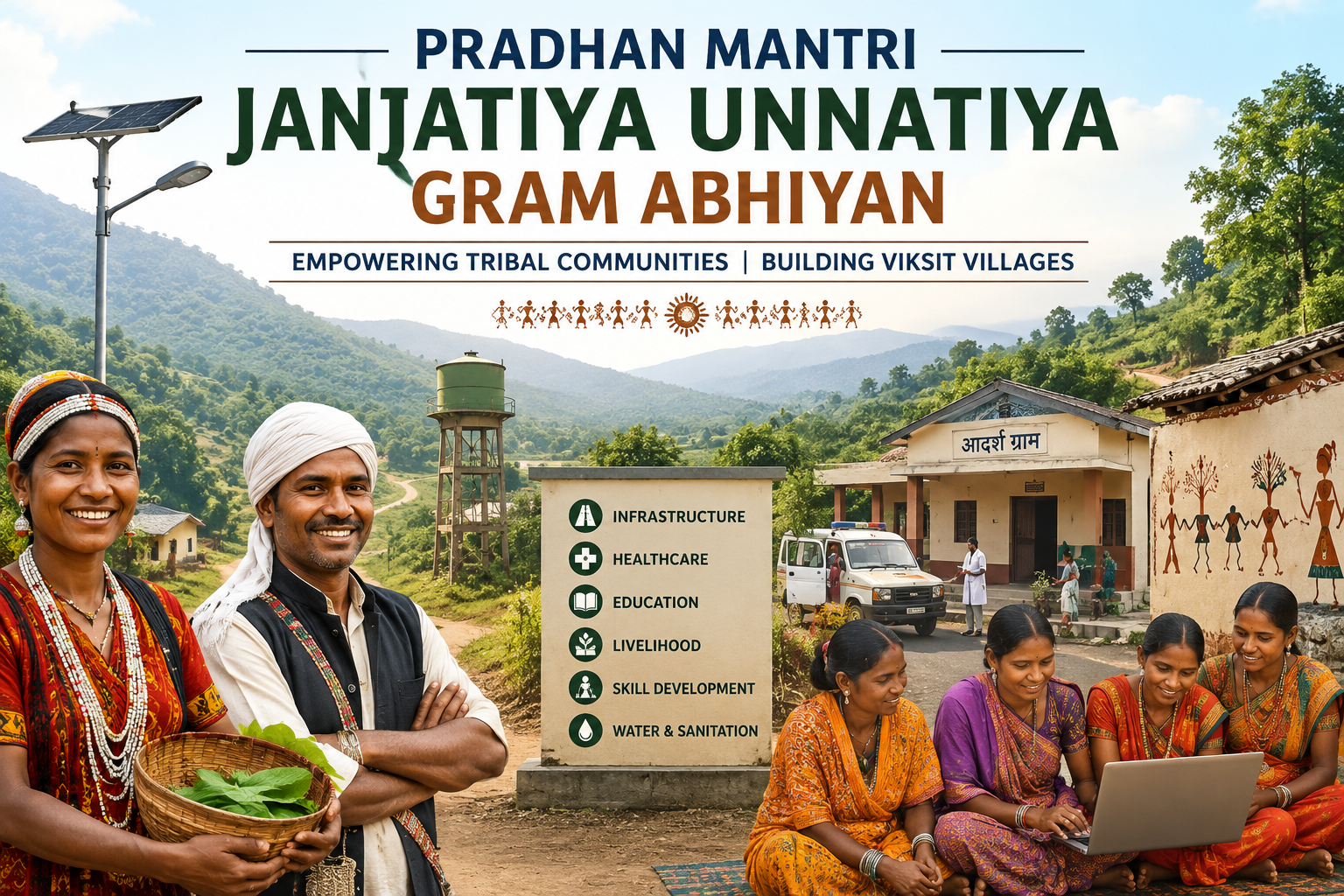
Also Read: Pradhan Mantri Janjatiya Unnat Gram Abhiyan: Saturation Coverage for Tribal Families