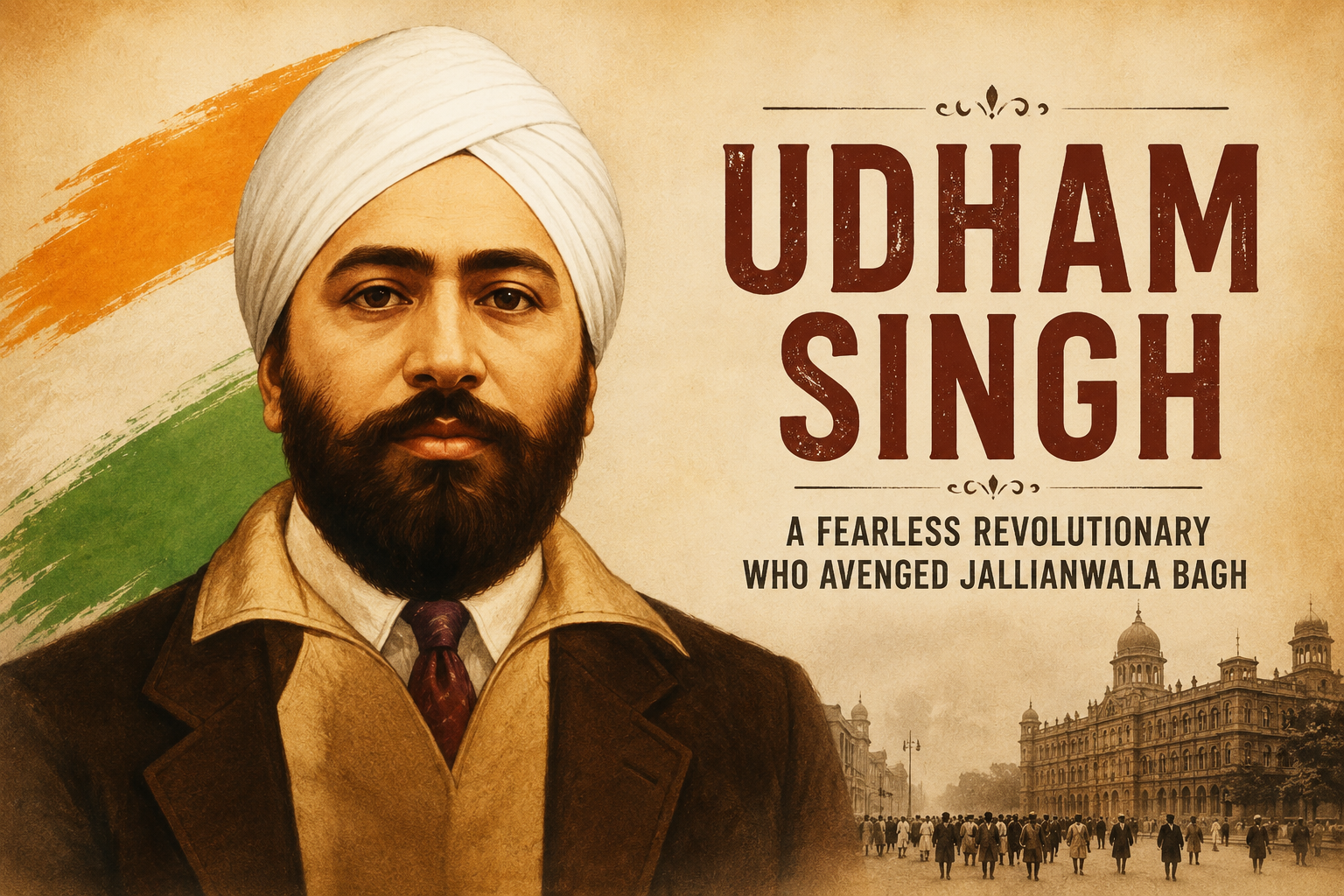
Every year, India observes July 31 as Shaheed Udham Singh Martyrdom Day, commemorating one of the most courageous revolutionaries of the Indian independence movement. Udham Singh is remembered for his fearless fight against British colonial rule and his daring act of revenge for the Jallianwala Bagh massacre, an incident that left an indelible mark on India’s struggle for freedom.
Shaheed Udham Singh Martyrdom Day
- The Haryana government has announced that July 31 will be a gazetted holiday in honor of Udham Singh.
- On July 31, 1940, Udham Singh an Indian Freedom fighter was executed at Pentonville Prison in London for assassinating Michael O’Dwyer, the former Lieutenant Governor of Punjab.
- Udham Singh’s assassination of O’Dwyer was in direct response to the 1919 Jallianwala Bagh massacre, a brutal massacre of hundreds of unarmed Indians by British troops.
- Today, Udham Singh is celebrated as a symbol of bravery, patriotism, and unity, inspiring generations of Indians.
Early Life of Udham Singh
Udham Singh was born as Sher Singh on December 26, 1899, in Sunam, Punjab, located in the Sangrur district. He later became known as Shaheed-i-Azam Sardar Udham Singh, meaning “Great Martyr.”
- His father, a railway crossing watchman, passed away when Udham Singh was young.
- After his father’s death, he and his brother were admitted to the Central Khalsa Orphanage in Amritsar, where he received his early education.
- Udham Singh passed his matriculation in 1918 and left the orphanage in 1919.
- The Jallianwala Bagh massacre on April 13, 1919 profoundly influenced him, motivating him to join the revolutionary struggle against British rule.
- He was deeply inspired by fellow revolutionaries like Bhagat Singh and quickly became active in political movements.
Revolutionary Activities and Contributions
Udham Singh’s revolutionary career spanned India and abroad. He believed in uniting Indians against colonial oppression and took bold steps to challenge British authority.
- In 1924, Udham Singh joined the Ghadar Party, founded by Sohan Singh Bhakna in 1913 in California, aimed at organizing Indians living abroad for the independence movement.
- He was detained in 1927 for illegal possession of weapons and sentenced to five years in prison.
- In 1934, Udham Singh traveled to London with a mission to assassinate Michael O’Dwyer, who had approved Brigadier Dyer’s actions during the Jallianwala Bagh massacre.
- On March 13, 1940, he shot O’Dwyer at Caxton Hall, London. He was arrested immediately, held in Brixton Prison, sentenced to death, and hanged on July 31, 1940, at Pentonville Prison.
- During his trial, Udham Singh adopted the name “Ram Mohamed Singh Azad”, symbolizing Hindu-Sikh-Muslim unity.
- His remains were returned to India in 1974 and cremated in his village Sunam, honoring his lifelong dedication to the nation.
Legacy of Udham Singh
Udham Singh’s legacy is celebrated both in India and abroad:
- A charity in Birmingham, UK, and a museum near Jallianwala Bagh in Amritsar commemorate his life.
- His personal belongings, including his knife, diary, and a bullet from the assassination, are preserved in the Black Museum of Scotland Yard.
- Films based on his life include JallianWala Bagh (1977), Shaheed Uddham Singh (1977), and Shaheed Uddham Singh (2000).
- The Udham Singh Nagar district in Uttarakhand is named after him.
- A 10-foot tall statue of Udham Singh was unveiled in 2018 at the main entrance of Jallianwala Bagh, Amritsar, by the then Union Home Minister Rajnath Singh.
- Various memorials, including Shaheed Udham Singh Chowk in Anupgarh, Rajasthan, and musical tributes like the 1998 track “Assassin” by the Asian Dub Foundation, keep his memory alive.
Jallianwala Bagh Massacre: The Turning Point
The Jallianwala Bagh massacre, also called the Amritsar massacre, was a pivotal event that defined Udham Singh’s revolutionary path.
- On April 13, 1919, British Indian Army troops under Brigadier-General R.E.H. Dyer opened fire on a peaceful gathering in Jallianwala Bagh, killing hundreds of unarmed men, women, and children.
- The crowd had assembled to protest the Rowlatt Act, which allowed the British to detain Indians without trial.
- The massacre followed the arrest of nationalist leaders Saifuddin Kitchlew and Dr. Satyapal, which sparked widespread protests.
- The tragedy became a major catalyst for Mahatma Gandhi’s Non-Cooperation Movement (1920–22).
- Poet Rabindranath Tagore renounced his knighthood in protest, and the Hunter Commission (1920) censured General Dyer.
Conclusion
Udham Singh remains a towering figure in India’s struggle for independence. His act of vengeance for the Jallianwala Bagh massacre symbolized the courage, unity, and determination of Indian revolutionaries. Each year, on Shaheed Udham Singh Martyrdom Day, the nation honors his sacrifice and remembers his extraordinary contributions to India’s freedom. His life is not just a story of rebellion, but a testament to bravery, justice, and unwavering patriotism
To Download Monthly Current Affairs PDF Click here
Click here to get a free demo
Discover all about CLAT Exam