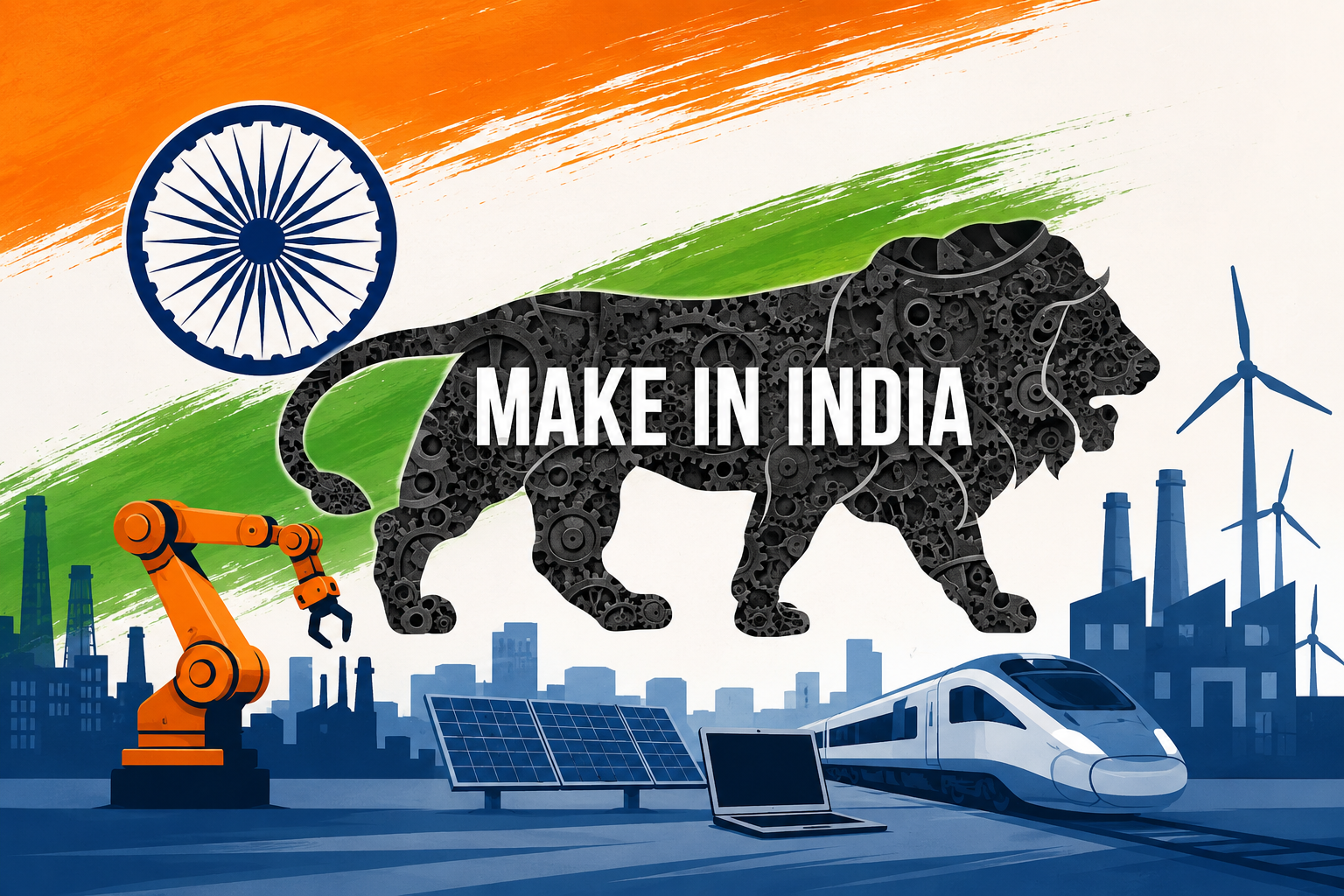
The Make in India initiative, launched by Prime Minister Narendra Modi on September 25, 2014, has completed 11 years. Designed as a flagship program to transform India into a global manufacturing hub, it has played a pivotal role in shaping industrial growth, attracting investments, creating jobs, and boosting India’s position on the global economic map.
This initiative emerged at a time when India’s economic growth was slowing, with the 2013 growth rate marking a decade-low. Make in India sought to revive manufacturing, strengthen industrial capabilities, and improve India’s competitiveness internationally.
Why Make in India Was Launched
By 2013, India faced an economic slowdown, with manufacturing contributing only a modest share to GDP. The Make in India initiative was launched with multiple objectives:
- Boost Manufacturing: Increase the share of manufacturing in India’s GDP and reduce dependence on imports.
- Attract Investments: Encourage domestic and foreign investment through simplified regulations and policy support.
- Promote Innovation & Skill Development: Build a future-ready workforce capable of meeting industrial challenges.
- Protect Intellectual Property: Ensure that innovations in India are adequately protected through modern IPR frameworks.
- Build World-Class Infrastructure: Develop industrial corridors, smart cities, and logistics networks to support manufacturing.
In essence, Make in India aims to transform India into a self-reliant industrial powerhouse while generating employment for the country’s young population.
Key Sectors Under Make in India
The initiative initially focused on 27 sectors, divided into manufacturing and service sectors, representing India’s industrial and service potential.
Manufacturing Sectors
- Aerospace and Defence
- Automotive and Auto Components
- Pharmaceuticals and Medical Devices
- Biotechnology
- Textiles and Apparels
- Chemicals and Petrochemicals
- Electronics System Design and Manufacturing (ESDM)
- Food Processing
- Gems and Jewellery
- Railways
- And more
Service Sectors
- Information Technology (IT) and IT-enabled Services (ITeS)
- Tourism and Hospitality
- Medical Value Travel
- Transport and Logistics Services
- Accounting and Finance Services
- Audio Visual and Legal Services
Focusing on these sectors allows Make in India to target both high-tech industries and traditional sectors, ensuring broad-based economic growth.
The 4 Pillars of Make in India
Make in India is built on four strong pillars that guide its implementation:
- New Processes: Promote entrepreneurship, support startups, and improve the ease of doing business in India.
- New Infrastructure: Develop industrial corridors, smart cities, and modern manufacturing hubs integrated with advanced technology.
- New Sectors: Open new avenues for Foreign Direct Investment (FDI) in sectors like Defence, Insurance, Medical Devices, and Railways.
- New Mindset: Transform the government’s role from regulator to facilitator, working closely with industry to support growth and innovation.
These pillars collectively aim to create a holistic ecosystem that supports manufacturing, innovation, and investment.
Key Initiatives Under Make in India
Several initiatives have been launched under the Make in India umbrella to achieve its ambitious objectives:
- Production-Linked Incentive (PLI) Schemes
PLI schemes cover 14 key sectors, encouraging domestic manufacturing, integrating advanced technologies, and improving India’s global competitiveness.
- PM GatiShakti
Aimed at achieving Aatmanirbhar Bharat and a $5 trillion economy by 2025, PM GatiShakti focuses on multimodal infrastructure development. It covers seven “engines”:
- Railways
- Roads
- Ports
- Waterways
- Airports
- Mass Transport
- Logistics Infrastructure
This initiative enhances connectivity and reduces logistical bottlenecks for manufacturers.
- Semiconductor and Display Ecosystem
India is investing in semiconductors and electronics manufacturing through multiple schemes, including:
- Setting up semiconductor and display fabs
- Encouraging Design Linked Incentive (DLI) programs
- Building an indigenous ecosystem for semiconductors, silicon photonics, sensors, and related ATMP/OSAT facilities
This effort is critical for India’s self-reliance in electronics and high-tech manufacturing.
- National Logistics Policy & Industrial Corridors
To complement PM GatiShakti, the National Logistics Policy focuses on soft infrastructure improvements, standardization, logistics parks, and human resource development. Industrial corridors aim to create smart cities and modern manufacturing hubs, reducing production and transportation costs.
- Startup India, GST, UPI, and Ease of Doing Business
Startup India programs support entrepreneurs and job creators. The implementation of GST simplifies taxation, while UPI enhances the digital economy. Together, these reforms improve ease of doing business, attract investment, and encourage innovation.
Key Achievements of Make in India
Over 11 years, Make in India has delivered measurable results:
- FDI Growth: $667 billion from 2014 to 2024, a 119% increase over the previous decade.
- Ease of Doing Business: Ranking improved from 142 (2014) to 63 (2020).
- Manufacturing Boom: India became the second-largest mobile phone manufacturer globally, producing 330 million units in 2023–24.
- Defense Production: INS Vikrant and defense exports of ₹21,083 crore in FY 2023–24.
- Export Growth: Merchandise exports reached $437 billion in FY 2023–24, led by electronics, pharmaceuticals, and automotive sectors.
- Job Creation: Millions of jobs in electronics, textiles, and allied industries.
- Infrastructure Expansion: Development of industrial corridors, smart cities, and logistics improvements.
- PLI Schemes: Encouraged investment, domestic production, and integration into global value chains.
Challenges and Criticism
Despite significant achievements, Make in India faces ongoing challenges:
- Manufacturing jobs remain limited; contribution to GDP is still low (15.9% in 2023–24).
- High-tech sectors like semiconductors still rely heavily on imports.
- Logistics costs remain higher than in developed economies.
- Bureaucratic delays and regulatory hurdles persist in some sectors.
- Trade imbalances continue, affecting self-reliance goals.
Conclusion
After 11 years, Make in India has transformed India’s industrial landscape, attracting investment, creating jobs, and modernizing infrastructure. While challenges remain, initiatives like PLI, PM GatiShakti, and the semiconductor ecosystem continue to drive India toward self-reliance in manufacturing and a stronger global presence.
With continued focus on infrastructure, innovation, and investment, Make in India remains central to India’s journey toward economic growth and industrial leadership.
To Download Monthly Current Affairs PDF Click here
Click here to get a free demo
Discover all about CLAT Exam