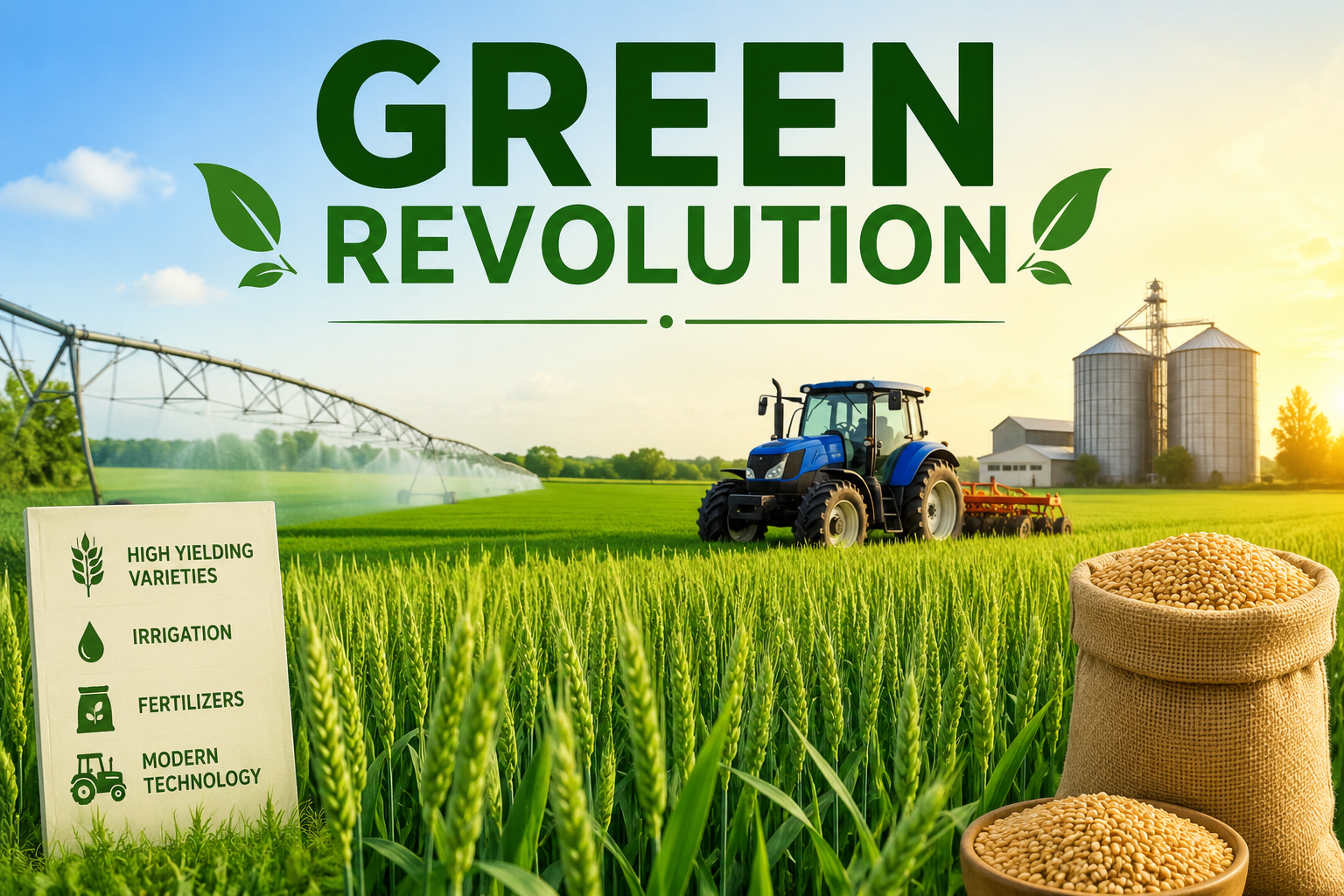
The crop of maize has also undergone a Green Revolution in India, with its annual output increasing more than three times between 1999–2000 and 2023–24.
Key Points on Green Revolution in Maize
- The Green Revolution was initially focused on wheat and rice, making India self-sufficient—and even surplus—in these cereal grains.
- High-yielding maize varieties were bred by institutions like CIMMYT (Mexico) and IARI (New Delhi), guided by legendary scientists like Norman Borlaug and M. S. Swaminathan.
- Maize output has risen from 11.5 million tonnes to over 35 million tonnes, and average yields have increased from 1.8 to 3.3 tonnes per hectare.
Significance of Maize Cultivation
- Unlike rice and wheat, maize is not primarily a food grain in India.
- Only around 20% of maize is used for direct human consumption.
- Around 60% goes into animal feed—particularly for poultry—making it indirectly consumed as meat, eggs, or milk.
- About 14–15% is used in industrial sectors like textiles, paper, pharmaceuticals, food, and beverages.
- Maize for ethanol is a growing trend, especially during the off-season for sugarcane.
- Waxy maize hybrids with high amylopectin starch (e.g., AQWH-4) have made maize more suitable for ethanol production.
- Pusa Waxy Maize Hybrid-1 offers 71–72% starch, with a 68–70% recovery rate, increasing ethanol yield per tonne.
Recent Developments in Maize Revolution
- IARI developed India’s first waxy maize hybrid with high amylopectin, optimized for ethanol recovery.
- The hybrid has a potential yield of 8.8 tonnes per hectare and is ready for commercial cultivation.
- Partnership with Uttar Pradesh Distillers’ Association has been established for field trials.
- CIMMYT set up a doubled haploid (DH) breeding facility in Karnataka, enabling faster breeding of genetically pure inbred lines.
- Over 29,000 DH lines have been developed, enhancing breeding efficiency.
- Unlike wheat and rice (self-pollinating), maize is cross-pollinating, making it ideal for hybrid development.
- Private seed companies like Mahyco, Shriram Bioseed, and Advanta Seeds now breed 80% of India’s maize area using hybrid varieties.
- CIMMYT shares its improved lines with public and private players, accelerating growth and innovation.
Current Status of Maize in India
- As per APEDA, India is the 5th largest maize producer (2.59% of global production in 2020).
- Maize ranks third in Indian cereal production after rice and wheat.
- It accounts for around 10% of total food grain output.
- Yield improvements: from 1.8 to 3.3 tonnes/hectare.
- Major maize-producing states:
- Karnataka, Madhya Pradesh, Bihar, Tamil Nadu, Telangana, Maharashtra, Andhra Pradesh
- Maize is cultivated year-round, with 85% grown during the Kharif season.
- In 2022–23, India exported 3.45 million tonnes worth ₹8,987.13 crores.
- Export destinations: Bangladesh, Vietnam, Nepal, Malaysia, Sri Lanka.
Historical Context: The Original Green Revolution
- The Green Revolution began in mid-1960s, transforming Indian agriculture.
- Led by M. S. Swaminathan, who collaborated with Norman Borlaug, it introduced Mexican dwarf wheat varieties to India.
- Thousands of test plots were established in 1965, showing farmers that new wheat varieties could thrive.
- Wheat production jumped from 12 to 23 million tonnes in just four seasons, reducing India’s dependency on imports.
Why the Green Revolution Was Necessary
- India was facing a food crisis in the 1960s due to:
- Rapid population growth
- Low productivity
- Frequent droughts
- Dependence on imports
- Political pressure from donor countries (e.g., the U.S.) made India vulnerable.
- Aimed for self-reliance, poverty reduction, and modernization of agriculture.
Key Features of the Green Revolution
- High-Yielding Variety (HYV) seeds
- Use of chemical fertilizers and pesticides
- Introduction of modern farm equipment
- Expansion of irrigation
- Multiple cropping
- Credit and subsidy support
- Minimum Support Prices (MSP)
- Boosted R&D and agricultural extension
Conclusion: A Green Revolution in Maize
Though quieter than the revolutions in wheat and rice, the Green Revolution in maize is reshaping India’s agricultural economy. With rising yields, diversified uses, and technological breakthroughs, maize is now a major contributor to India’s food security, export economy, and biofuel ambitions. Strategic investments by public institutions like IARI and CIMMYT, along with private-sector breeding, have positioned maize as a pillar of modern Indian agriculture.
To Download Monthly Current Affairs PDF Click here
Click here to get a free demo
Discover all about CLAT Exam