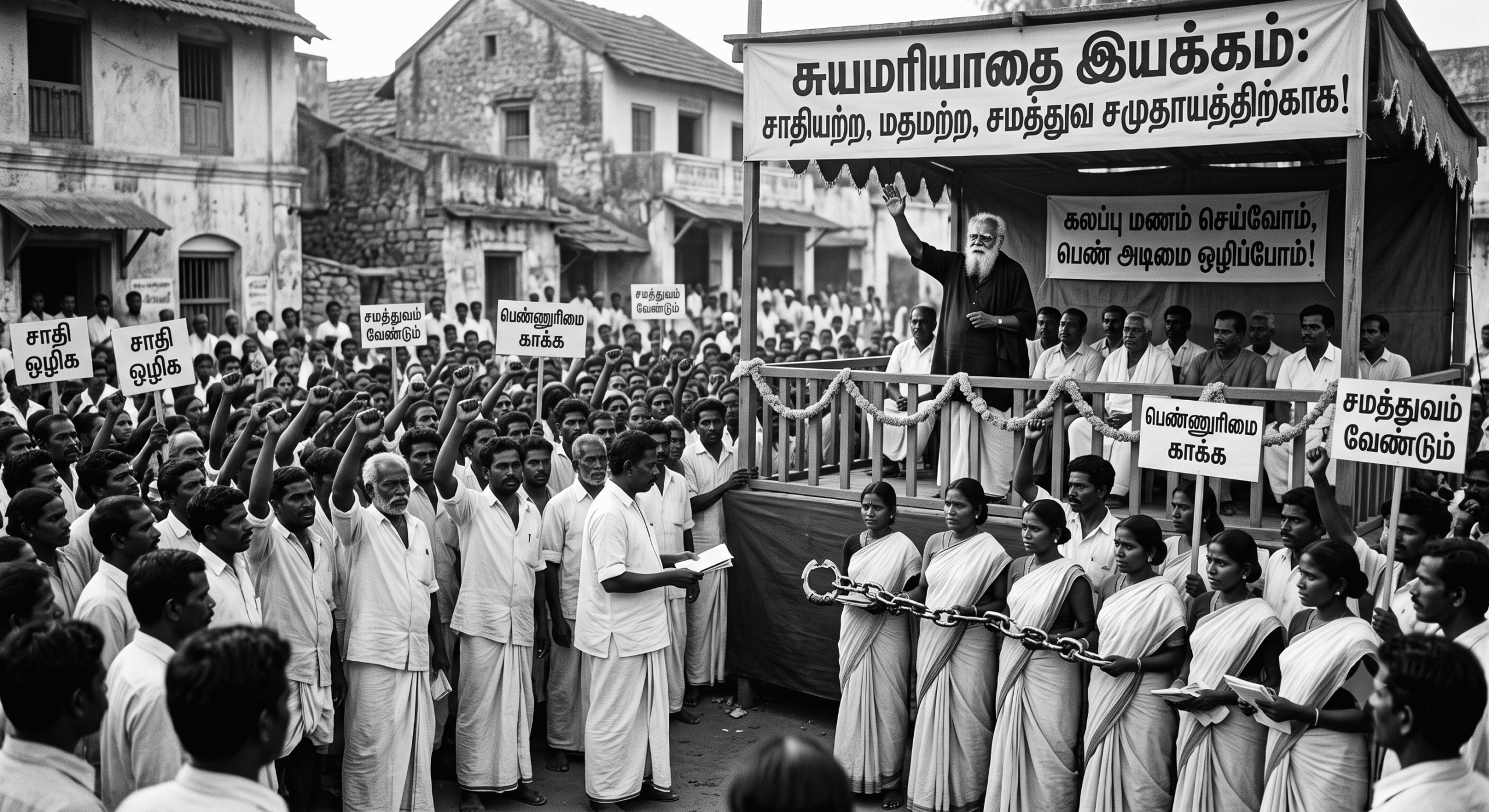
The struggle for civil rights and social equality in India has taken many forms, but few initiatives have been as radically transformative as the Self-Respect Movement. Founded in 1925 by E.V. Ramasamy (popularly known as Periyar) in Tamil Nadu, this formidable socio-political crusade recently marked its historic 100th anniversary. The movement reshaped the cultural landscape of Southern India by demanding absolute equality for non-Brahmin communities, challenging deeply entrenched social hierarchies, and pioneering a distinct regional identity.
Periyar, originally a prominent leader within the Indian National Congress, conceptualized the Self-Respect Movement after resigning from the party in 1925 over disagreements regarding communal representation. Inspired by the egalitarian philosophies of earlier social reformers like Jyotirao Phule and his contemporary B.R. Ambedkar, Periyar sought to create a society where an individual’s dignity was not dictated by birth.
The Vision Behind the Movement: Core Principles and Rationalism
The foundational objective of the Self-Respect Movement was the complete annihilation of the caste system and the dismantling of Brahminical orthodoxy. Rather than seeking upward mobility within the existing religious framework, the movement advocated for a psychological liberation rooted in rationalism and self-worth.
Key Tenets of Periyar’s Crusade
The ideological framework of the movement was heavily disseminated through progressive publications like Namathu Kurikkol and Tiravitak Kalaka Lateiyam. These texts outlined several core principles:
- Rejection of Superstition: The movement promoted scientific temper and rational thinking while aggressively critiquing orthodox mythologies that justified social stratification.
- Democratization of Spaces: It opposed the construction of religious institutions that reinforced untouchability and barred marginalized groups from entry.
- Gender Equality and Women’s Rights: Far ahead of its time, the movement advocated for women’s property rights, widow remarriage, access to education, and bodily autonomy.
- Self-Respect Marriages (Suyamariyathai Kalyanam): To break the shackles of ritualistic dominance, the movement introduced marriages conducted without Brahmin priests, holy fires, or caste-based rituals. These contracts were based entirely on mutual consent and equality.
Historical Backdrop: The Mechanics of Caste and Colonial Policy
To understand why the Self-Respect Movement resonated so deeply, it is essential to examine the rigid social realities of late 19th and early 20th-century India. Caste functioned as a network of watertight social compartments, where daily life was strictly governed by notions of ritual purity and pollution.
Colonial Formalization of Division
The British colonial administration inadvertently or strategically hardened these divisions through legislative actions. The introduction of the Criminal Tribes Act of 1871 (extended to Madras Presidency in 1911) allowed the state to designate entire hereditary communities as continuous criminals, restricting their employment and reinforcing systemic biases.
Following the Revolt of 1857, the colonial government also adjusted its administrative strategies. By embedding caste criteria directly into provincial education eligibility and public sector employment, colonial policies heightened competition between communities, inadvertently setting the stage for organized non-Brahmin political mobilization.
Champions of Caste Reform: A Comparative Overview
The Self-Respect Movement was part of a larger, multi-regional tapestry of anti-caste activism across India. Prominent leaders utilized different methodologies to achieve the shared goal of social emancipation.
| Reformer / Group | Region & Timeline | Core Strategy & Focus |
| Jyotirao Phule | Maharashtra (1827–1890) | Founded Satya Shodhak Samaj; championed lower-caste education and women’s rights; coined the term “Dalit.” |
| Sree Narayana Guru | Kerala (1856–1928) | Led spiritual reforms; consecrated temples open to all castes; promoted the doctrine of “One Caste, One Religion, One God.” |
| Periyar E.V. Ramasamy | Tamil Nadu (1879–1973) | Launched the Self-Respect Movement; championed institutional rationalism, atheism, and Suyamariyathai marriages. |
| B.R. Ambedkar | Pan-India (1891–1956) | Led Mahad Satyagraha; architect of India’s Constitution; secured institutional reservations and political safeguards for marginalized groups. |
| Dalit Panthers | Maharashtra (1970s) | Inspired by the US Black Panther Party; utilized radical socio-political activism and literature to resist discrimination. |
Parallel Currents: Movements That Shaped Social Change
Beyond individual reformers, a succession of historical and spiritual milestones gradually chipped away at orthodox social structures over the centuries:
The Bhakti Movement (7th to 17th Centuries)
Centuries before modern political mobilization, medieval saint-poets like Kabir, Ravidas, Mirabai, and Tukaram challenged religious hierarchies. By emphasizing direct personal devotion over rigid ritualism, they laid early cultural foundations for human equality.
Reform Societies: Prarthana Samaj & Arya Samaj
In the late 19th century, organizations like Maharashtra’s Prarthana Samaj (1867) and North India’s Arya Samaj (1875) actively advocated for social reforms. They challenged Brahminical monopolies by promoting inter-caste dining, women’s literacy, and widow remarriage.
Temple Entry Movements
Mass mobilizations in Kerala and Tamil Nadu directly challenged restrictions on sacred spaces. Figures like Sree Narayana Guru and Ayyankali led aggressive agitations, paving the way for historical legislations that legally opened temple doors to all communities regardless of birth.
Turning Points in Legal and Constitutional Reform
The pressure applied by the Self-Respect Movement and parallel civil rights crusades fundamentally reshaped the legal and constitutional architecture of modern India. These legal shifts occurred across three distinct waves:
- The Poona Pact (1932): An agreement between B.R. Ambedkar and Mahatma Gandhi that reserved 147 seats for Scheduled Castes (SCs) within the general electorate rather than separate electorates, introducing early affirmative frameworks during the colonial era.
- Constitutional Provisions (1950): India’s founding document outlawed caste discrimination. Article 15 prohibited discrimination based on caste or sex, Article 17 legally abolished “Untouchability” in all its forms, and Articles 330 and 332 guaranteed reserved legislative representation at both federal and state levels.
- The Prevention of Atrocities Act (1989): This legislation criminalized targeted physical, sexual, and social abuse against SC and ST communities, establishing speedy, specialized courts to enforce protection against systemic violence.
Ripples of Change: The Enduring Legacy of Periyar’s Vision
The long-term impact of the Self-Respect Movement extends far beyond historical timelines. Ideologically, the movement eventually evolved into the Dravidar Kazhagam, which served as the structural baseline for the major Dravidian political parties that continue to dominate Tamil Nadu’s governance.
By tying social welfare directly to political consciousness, the movement transformed the state into an early incubator for robust affirmative action and inclusive development. From the legal validation of priestless marriages to the vibrant growth of Dalit literature and identity assertion, the legacy of the movement remains a vital, living force in the ongoing global fight against systemic discrimination.
Read more:
- Space Science: Aditya L1 Mission 2026: Latest Discoveries from the Sun
- Academic Success: BSEB 10th Result 2026 – Direct Link & Updates