The USS Gerald R. Ford aircraft carrier returned to the United States on Saturday following a 326-day deployment that included a mission to the Middle East, illustrating how America’s global naval posture continues to respond to international flashpoints. To truly understand the origin of these global superpower deployments and the containment strategies that shaped modern naval mobility, one must look back at the defining crucible of asymmetric combat: the Vietnam War.
Below is the complete, high-volume SEO structural breakdown of the conflict, mapped chronologically in crisp, highly readable points.
The Seeds of Conflict: Colonial Roots and the Rise of Ho Chi Minh
- French Colonial Foundations: Vietnam was colonized by France in the late 19th century, officially becoming a key administrative territory of French Indochina in 1887.
- Western Impositions: French rule structurally introduced Western education, Roman Catholicism, and a highly centralized, plantation-based economy, with major lucrative activities concentrated around Saigon in southern Vietnam.
- Early Resistance: This foreign economic and social dominance quickly sparked early independence movements among the Vietnamese, though France successfully maintained strict administrative control until World War II.
- The Japanese Occupation: During the global war, imperial Japan occupied Vietnam between 1941 and 1945, a move that severely weakened French authority and vastly accelerated the localized struggle for absolute independence.
- Emergence of the Viet Minh: During this Japanese occupation, a nationalist and communist-led resistance movement called the Viet Minh was formed under the strategic direction of Ho Chi Minh.
- Ideological Fusion: The Viet Minh uniquely combined Marxist-Leninist ideology with fierce Vietnamese nationalism, effectively forging a disciplined, highly motivated liberation network across the country.
- Declaration of Sovereignty: Following Japan’s ultimate defeat in 1945, Ho Chi Minh officially declared Vietnam’s sovereign independence, but a determined France immediately attempted to reclaim its colonial possessions.
- The First Indochina War: This territorial friction exploded into the First Indochina War (1946–1954), fought bitterly between the communist Viet Minh and French colonial forces.
- The Battle of Dien Bien Phu: The Viet Minh’s historic conventional victory at Dien Bien Phu in 1954 permanently shattered French military resolve, forcing France to withdraw from Vietnam entirely.
A Divided Nation and the Cold War Geopolitical Trigger
- The 17th Parallel Partition: The 1954 Geneva Conference temporarily divided the nation along the 17th parallel to facilitate a peaceful administrative transition.
- The Communist North: North Vietnam, established under the leadership of Ho Chi Minh, was controlled by a centralized communist regime with its capital in Hanoi.
- The Anti-Communist South: South Vietnam was set up under the leadership of Ngo Dinh Diem and was aggressively backed by Western powers as a capitalist, anti-communist buffer zone.
- The Domino Theory Imperative: The United States evaluated this regional division strictly through the global lens of the Cold War, fearing that communist expansion in Southeast Asia would cause surrounding countries to collapse like dominoes.
- Containment via Aid: Driven by this strategic fear, Washington poured vast amounts of political, financial, and military assistance into South Vietnam to contain the spread of communism.
- The Insurgency Escalation: Tensions soon reached a breaking point as the communist-backed Viet Cong guerrilla insurgency actively targeted and destabilized the South Vietnamese government.
- Incremental American Involvement: The United States steadily expanded its operational role in the early 1960s, deploying increasing numbers of military advisers under Presidents John F. Kennedy and Lyndon B. Johnson to prevent a total collapse.
The Full-Scale Vietnam War: Escalation and Attrition Strategy
- The Combat Catalyst: In 1965, the United States launched direct, large-scale combat operations, marking the official transformation of the advisory mission into the full-scale Vietnam War.
- The Gulf of Tonkin Incident: In August 1964, a critical naval clash occurred when North Vietnamese forces allegedly attacked U.S. warships in the Gulf of Tonkin.
- The Congressional Mandate: In response, the U.S. Congress passed the Gulf of Tonkin Resolution, granting President Lyndon B. Johnson broad executive authority to escalate military action without a formal war declaration.
- Ground Troop Deployment: In March 1965, the first official U.S. ground combat troops landed near Da Nang, permanently changing the nature of the ground war.
- Troop Level Surges: By the end of 1965, U.S. troop deployments soared to 200,000, eventually peaking at an immense force of over 543,000 personnel in 1969.
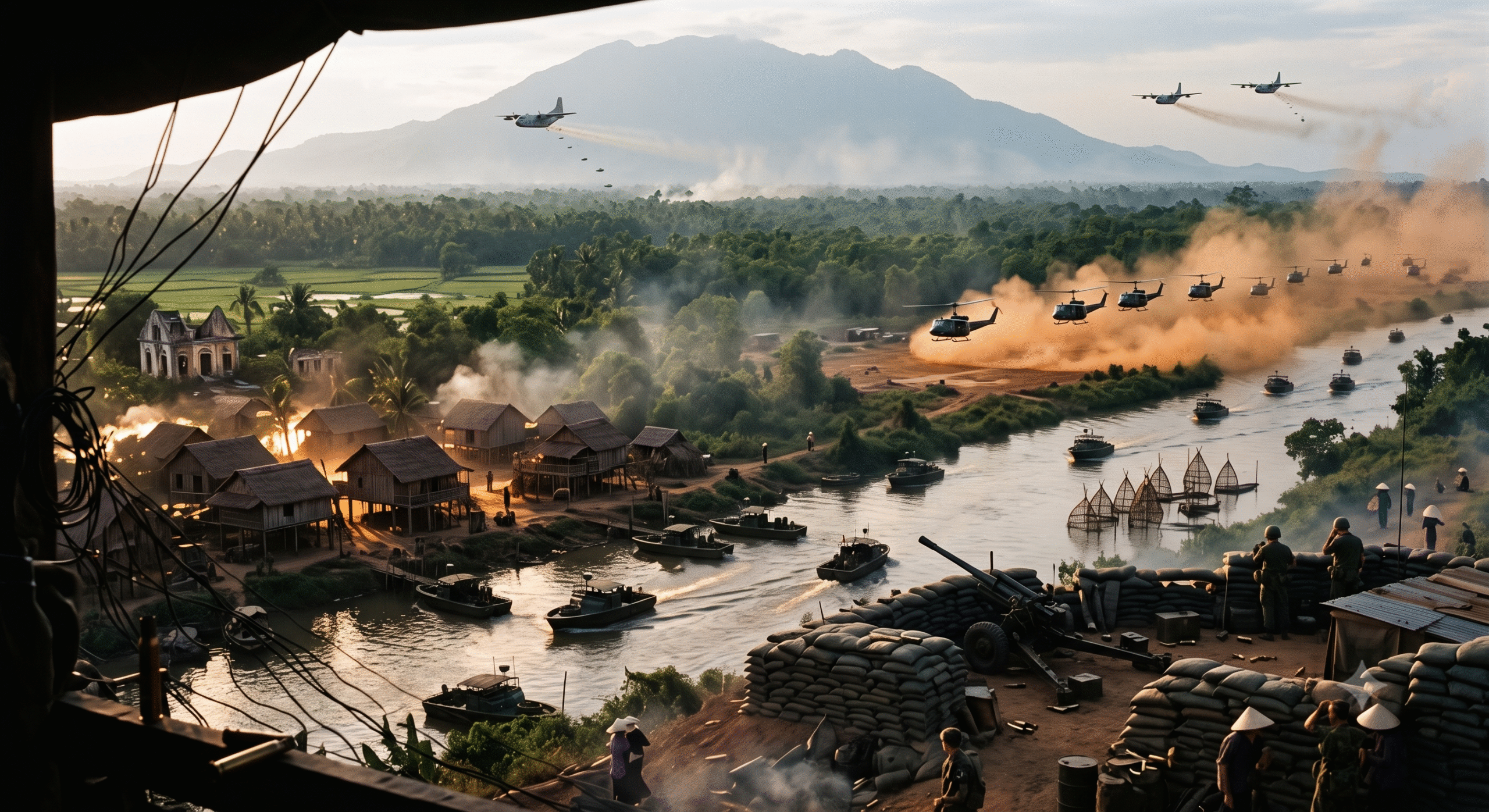
- The Doctrine of Attrition: Operating under General William Westmoreland, U.S. forces utilized an attrition strategy, attempting to exhaust the NVA and Viet Cong through superior mobility and overwhelming firepower.
- The Battle of Ia Drang (1965): This was the first major conventional, direct clash between U.S. regular army forces and the North Vietnamese Army, validating airmobility tactics.
- Search-and-Destroy Campaigns: Large-scale maneuvers like Operation Cedar Falls (1967) targeted the “Iron Triangle” region to dismantle deeply embedded communist strongholds and tunnel networks.
- The Guerrilla Standoff: Despite utilizing vast technological superiority and intensive carpet-bombing, the conventional U.S. military struggled immensely against asymmetric guerrilla tactics and the dense jungle terrain.
Turning Points, Domestic Unrest, and Vietnamization
- The Tet Offensive (1968): A massive, surprise coordinated offensive by communist forces struck cities across South Vietnam. While it was a tactical failure for the communists, it shocked the American public and shattered domestic political support for the war.
- The My Lai Massacre: Exposed to the world in 1968, the systematic slaughter of hundreds of unarmed Vietnamese civilians by U.S. troops severely damaged America’s moral standing and supercharged global anti-war protests.
- Widespread Social Protests: By the late 1960s and early 1970s, anti-war demonstrations, campus strikes, and deep social polarization became completely widespread across the United States.
- Nixon’s Exit Strategy: Entering office in 1969, President Richard Nixon initiated the policy of Vietnamization, aiming to gradually draw down U.S. combat forces while transferring combat duties to the South Vietnamese Army (ARVN).
- Cross-Border Incursions: While troop numbers steadily decreased between 1969 and 1972, Nixon simultaneously authorized covert military incursions into Cambodia and Laos to destroy communist supply lines along the Ho Chi Minh Trail.
- The Paris Peace Accords (1973): Following intense negotiations led by Henry Kissinger and Lê Đức Thọ, all parties signed the accords, formally ending direct U.S. combat operations.
- The American Withdrawal: By March 1973, the last remaining American combat troops left the theater, leaving a structurally weakened South Vietnam to defend its borders alone.
- Ceasefire Failures: Both North and South Vietnamese forces frequently violated the provisions almost immediately, causing tactical fighting to resume without pause.
- The Final Conventional Offensive: In early 1975, North Vietnam mobilized a massive, multi-front conventional offensive that completely overwhelmed the remaining southern defenses.
- The Fall of Saigon: On April 30, 1975, communist tanks rolled into Saigon, marking the total collapse of South Vietnam and the definitive end of the Vietnam War.
- Communist Reunification: In 1976, North and South Vietnam were formally integrated under centralized communist governance, establishing the modern Socialist Republic of Vietnam.
The Devastating Human and Global Legacy
- Vietnamese Demographics: The war caused a catastrophic loss of human life, killing an estimated 2 million Vietnamese civilians and more than 1.3 million combatants.
- Chemical Ecocide: The widespread use of toxic chemical defoliants like Agent Orange permanently destroyed millions of acres of farmland and created severe, multigenerational health crises, including cancers and birth defects.
- Economic Devastation: Vital infrastructure and agricultural networks were completely ruined, leaving the reunified country to suffer from extreme poverty and food shortages for years.
- Post-War Repression: Hundreds of thousands of South Vietnamese citizens who had supported the U.S.-backed regime were systematically rounded up and placed in brutal re-education camps.
- The Boat People Crisis: This internal persecution forced nearly 800,000 individuals to flee the country as refugees, undertaking life-threatening journeys across the open sea.
- American Casualties: More than 58,000 American military personnel lost their lives, and hundreds of thousands returned home bearing deep physical injuries and severe Post-Traumatic Stress Disorder (PTSD).
- The Financial Toll: The conflict cost the U.S. treasury approximately $1 trillion in inflation-adjusted dollars, severely destabilizing the economy and fueling the record-high inflation of the 1970s.
- The Vietnam Syndrome Effect: The military failure created a deep-seated public and political skepticism regarding unilateral foreign military interventions, heavily restricting American foreign policy layout for decades.
India’s Non-Aligned Diplomatic Role
- Anti-Colonial Alignment: India’s diplomatic strategy during the Vietnam War was guided strictly by its commitment to anti-colonialism, national sovereignty, and the principles of the Non-Aligned Movement (NAM).
- Early Support for Hanoi: Prime Minister Jawaharlal Nehru traveled to both North and South Vietnam in 1954, explicitly expressing deep solidarity with Ho Chi Minh’s anti-colonial mission.
- The ICSC Leadership: India served as a key executive chair of the International Commission for Supervision and Control (ICSC), working to monitor the 1954 Geneva Accords and consistently pushing for negotiated settlements.
- Shifting Dynamics: While relations cooled slightly following the 1962 Sino-Indian War due to shifting global axes, India steadily increased its diplomatic support for North Vietnam and the Viet Cong as the American bombing campaigns intensified.
- Expulsion and Recognition: New Delhi’s vocal anti-war stance caused South Vietnam to expel Indian officials from the ICSC in 1973. Despite this, India became one of the first non-communist nations to establish full diplomatic channels with the reunified Socialist Republic of Vietnam, laying the foundation for modern defense and economic cooperation.
The Macro Cold War Framework (1947–1991)
- The Ideological Bipolar System: The Vietnam War cannot be decoupled from the Cold War, which was a global, structural confrontation between the United States (capitalist democracy) and the Soviet Union (communist authoritarianism).
- The Nature of Proxy Conflicts: Running from 1947 until the dissolution of the USSR in 1991, this conflict relied on proxy wars, deep espionage networks, nuclear arms races, and competing military treaties (NATO vs. Warsaw Pact) to avoid a direct, civilization-ending nuclear war.
- The Ebb and Flow of Tensions: The global stand-off fluctuated constantly between terrifying focal points, like the Cuban Missile Crisis (1962), and prolonged periods of diplomatic détente. It ultimately concluded with the collapse of the Berlin Wall in 1989 and the fragmentation of the Soviet Union in 1991.
Also Read
- Policy Update: New Labour Codes 2026: Impacts on Modern Employment
- Space Science: Aditya L1 Mission 2026: Latest Discoveries from the Sun
- Academic Success: BSEB 10th Result 2026 – Direct Link & Updates