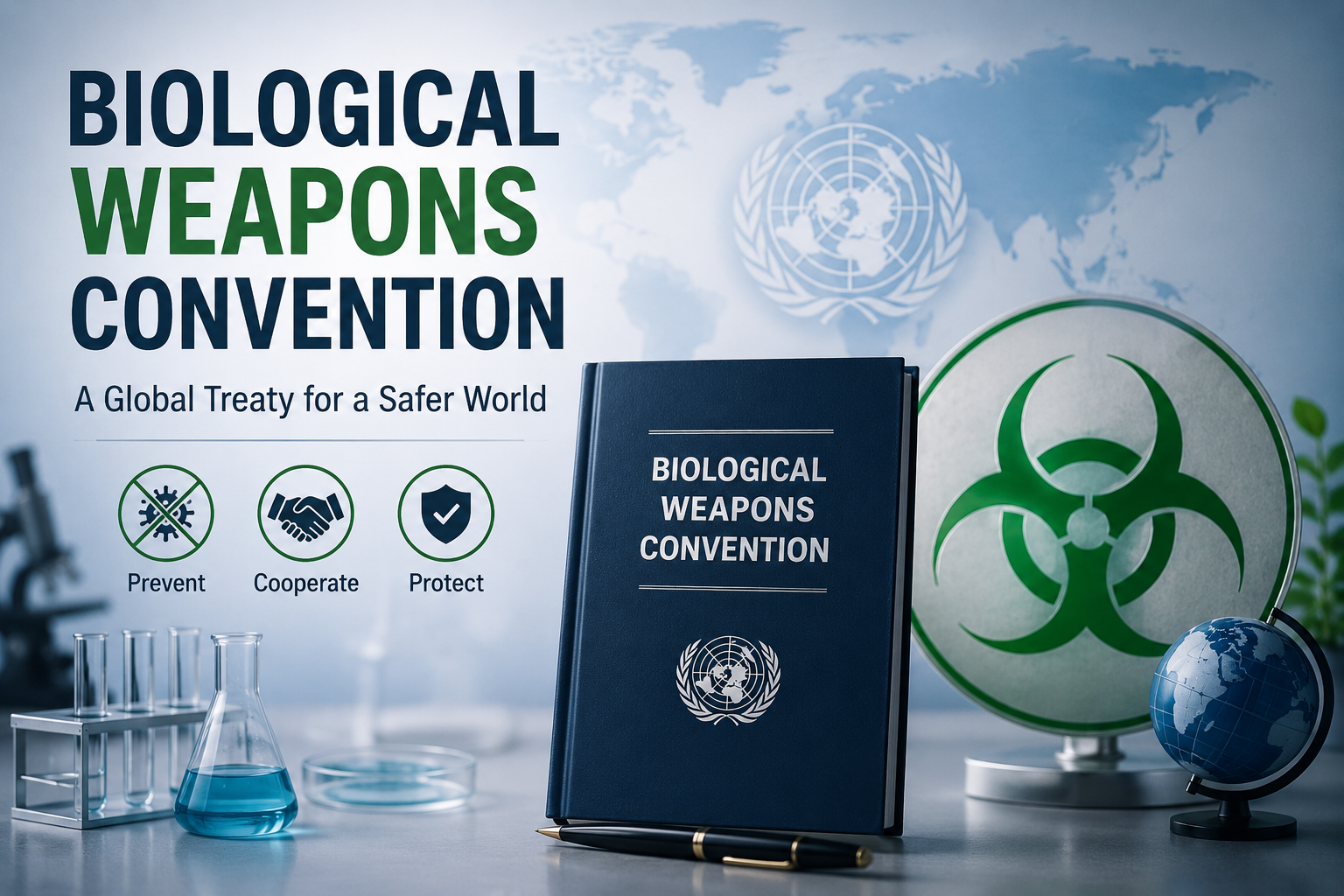
The year 2025–2026 marks a monumental milestone in international diplomacy: the completion of 50 years of Biological Weapons Convention (BWC) entry into force. Formally known as the Convention on the Prohibition of the Development, Production and Stockpiling of Bacteriological and Toxin Weapons, the BWC was the first multilateral disarmament treaty to ban an entire category of weapons of mass destruction. As we reflect on five decades of this landmark agreement, the global community faces a critical junction: how to evolve a 1975 treaty to meet 2026’s technological threats.
The Legacy of 50 Years of Biological Weapons Convention
Since March 26, 1975, the BWC has served as a stalwart bulwark against the deliberate misuse of biology. With 188 States Parties, the treaty has established a powerful global taboo against biological warfare.
Key Achievements Over Five Decades:
- Comprehensive Prohibition: Article I remains the heart of the convention, prohibiting the development, production, and stockpiling of biological agents that have “no justification for peaceful purposes.”
- Universal Norms: It has created a near-universal legal framework, with only a few nations remaining outside its jurisdiction.
- Disarmament Milestone: Unlike other treaties, the BWC mandated the complete destruction of existing stockpiles within nine months of entry into force.
India’s Leadership in the 50th Anniversary Year
India has emerged as a pivotal voice during the commemorations of 50 years of Biological Weapons Convention. In December 2025, New Delhi hosted the international conference “50 Years of BWC: Strengthening Biosecurity for the Global South.”
The “Bio-Secure Bharat” Vision
External Affairs Minister S. Jaishankar emphasized that while India celebrates 50 years of Biological Weapons Convention, the focus must shift to “Bio-Secure Bharat”—a framework integrating:
- One Health Approach: Linking human, animal, and environmental health.
- National Implementation: Oversight of dual-use research and high-risk pathogens.
- Global South Advocacy: Ensuring that developing nations have access to biotechnology for peaceful purposes while maintaining strict biosecurity standards.
Future Challenges: AI, Synthetic Biology, and Verification
As we look beyond 50 years of Biological Weapons Convention, the rapid acceleration of science and technology poses unprecedented risks. The convergence of Artificial Intelligence (AI) and Synthetic Biology has lowered the barrier to creating enhanced pathogens.
The “Verification Gap”
The most significant limitation remaining after 50 years of Biological Weapons Convention is the lack of a formal verification mechanism. Unlike the Chemical Weapons Convention, the BWC has no standing inspectorate.
- The AI Threat: Generative AI can now be used to design novel toxins, making traditional monitoring difficult.
- Dual-Use Dilemma: Facilities used for vaccine production can be repurposed for biological agents, complicating oversight without intrusive inspections.
Conclusion: Envisioning the Next 50 Years
Celebrating 50 years of Biological Weapons Convention is not just about looking back; it is a call to action. The 2025-2026 period has seen a renewed push for a “Special Conference” to agree on stronger verification mechanisms and an International Cooperation and Assistance Mechanism. For India and the world, the BWC remains the singular guardrail ensuring that the biological revolution benefits humanity rather than threatening its existence.
Read Also: The Path to a Plastic-Free Future: Understanding the Global Plastic Pollution Treaty